Showing posts with label classroom. Show all posts

Wednesday, April 3, 2019

"Can I Ask You a Question?": Power and Dominance in the Classroom

Image result for ask a question

            “Can I ask you a question?” students new to me ask.  I’m fond of answering (1) “You just did!” (pa dum da); and, (2) “Of course not! I’m your teacher.”  Blinks and winks. No one has ever questioned this question before.

            It troubles me, not only because we have become so unaware of our language (a topic addressed in other posts), but because it gives me, as the teacher, an additional layer of power and implicit dominance, that is untoward: A student has not only a right but a responsibility to himself, his teacher, and his classmates to ask questions.  I would place “Can I ask you a question?” on the left side of the power continuum, what I’ll call the “left-behind” side, where the student has the least amount of power (right above cowering silence).  For this post, we will focus on the student’s point of view.  Here’s the continuum:

                                                             Student Power

Silence   Can I ask?                                Discovery              You Can’t Teach Me   Silence

            On the other end of this continuum—what I’ll call the “I’m right” extreme is hostile silence, falling asleep, and any of the rude behaviors with which I regale you in The Rude Student.  Right next to that is You-Can’t-Teach behavior that attempts to wrest power from the teacher: statements and questions that are meant to establish the teacher’s limitations and to assume dominance over her. The student in this mode displays showing off behavior: bringing in topics and angles on the discussion in order to distract attention from the general proceedings in the class and onto herself.  We might call this being “The Devil’s Advocate,” which might, without the will-to-power, invoke the fulcrum Discovery mode. But too often, The Devil’s Advocate is challenging the teacher, not ideas.  This bravado is meant to hide a deep-seated feeling of inadequacy, a translation of the fear of the new, resistance to what might feel like a submission to learning something that she didn’t know before.  Another manifestation of this is the student who dismisses new ideas with such declarations as "I don't get it!"--meaning "it's not worth getting.  You're wasting my time." Whereas on the left side of the continuum the student is mired in inadequacy, on the other end the student is fighting to deny it.  On the left-behind side we have untoward submission, on the right, untoward dominance.  

            In the beginning of my teaching career, when I was the director of a developmental writing program—creating and coordinating courses in which students initially felt stigmatized as unbelonging dummies—I committed myself to notice and to diffuse power struggles in the classroom—to be awake to these dynamics and to replace them with, what all the Because I Can Teach posts assume, learning environments that are respectful, energizing, and geared toward mutual creation and discovery of new ideas and skills.

            So, the fulcrum, the middle of our continuum, is what I call the “Discovery” mode—not even the “Balance,” as that assumes a see-saw between “Left-Behind” and “I’m-Right.”  In this mode, students relax their fearful defensiveness to become active creators of knowledge in the classroom.  Questions and ideas flow freely.  Since there is no sense of “I’m better than you” in either direction, we appreciate each other’s contributions and revel in how we, in each meeting, become renewed.  To facilitate this, I model new ways of seeing and doing, and then release students to working with each other.  Ideally, they will hardly notice me floating between groups, so engrossed they are in their deliberations.

            I often say, “If I haven’t learned something new in a class meeting, then it wasn’t a good class.”  It means I repressed my students in some way, asserted dominance in a way I abhor—squelching their development.  On the other hand, it is also my devotion to notice when a student attempts to assume that position of dominance, which is so corrosive to group dynamics.  To help this student, who, in many ways, is less well off than the Left-Behind, find a way to new learning and legitimate power. Hence this blog post.

            And, yes, there are classes where the teacher is faltering—more interested in asserting dominance, hiding his own sense of inadequacy.  How can we, as students in such an environment, look for a way to turn it around for ourselves?  How can we make our time in such a situation an opportunity instead of a grind?  (For one, we can watch how the dynamics play out, as I am doing here.) 

            How are you in the classroom?  Where do you place on the continuum of power? How can you get off the see-saw to renew yourself?  What happens when you ask yourself, “What new, beneficial thing can I learn here, regardless?”  

           
Works Cited:

Because I Can Teach Link: 

             The Rude Student

Tuesday, March 19, 2019

Writers' Wrodeo: Workshop Whoas and Wonders


I know what it’s like to be the bronco.  I was four years old. The child of Hungarian immigrants.  Poor. My parents were separated. I was unable to speak or understand English.  Lonely. Unbelonging.  Helpless.  Defended.

            The kindergarten nun—I didn’t have a way of remembering an English name—had handed out flash cards for us to identify pictures with a word.  Of course, I didn’t, at the time, follow what this game was.  I had just come from being wrestled out of the protection of my coat.  I was hungry.  Why was I being subjected to this?

            All the other children were happily calling out words.  When it came my turn, I crossed my arms over my chest.  Pouted.  And shoved the flashcard away with the back of my hand.  I burst into tears.

            What happened next, I don’t know.  But I learned to speak, write, and read in English.  I have been teaching English, now, for over 40 years. My Hungarian father often bragged that a Hungarian girl was teaching the English English. But I feel helplessness and frustration in some students when I introduce new writing strategies in workshops.  The first round is always the toughest: “It’s my writing!” a student will often say, implying that I am violating her privacy.  “That’s the way I like it,” another will say (implying “hands-off!”).  Or, “You just want me to write the way you want me to write.”  The worst part of that is the implication that I’m being just as arbitrary as teachers who insist on the five-paragraph essay, or simply regurgitations of teacher’s opinions.

            In other blog posts, among them, “Reasons for Writing” and “Damning with Praise,” I offer ways in which to understand workshop dynamics. But the most difficult experience is the defensiveness and ego-attachment we are considering here.  And it often comes from experiences that have little to do with writing, per se, and everything to do with the vulnerabilities that come from the kinds of childhood trauma I described above.  If you are peripheralized in any way, especially because of things that you cannot help—nationality, gender, race, age, sexual-orientation, family, ability, or class—any suggestion that you can grow as a writer might feel like just another personal rejection—“Don’t be you. Be like me.”  If, in addition, you have only had single opportunities to hand in papers for a grade—which would make anyone feel anxious and helpless—then any recommendation for redrafting will raise a feeling of despair.

            I regularly meet now with my own colleagues to workshop my own writing—this post, too, has been vetted by my husband, for example. I’ve made many changes from my first draft, calling on the voices of my fellow writers in my head. My editors offer me suggestions, which  almost always help me to make significant breakthroughs in my work. But in the past, in the hands of workshop leaders that were writers but not teachers, I have walked away in tears.  Especially corrosive are those men who use workshops to court women.  (But that’s for another post.)  Then there are workshops where the leader assumes and maintains power by how she metes out attention and praise.  Cliques form. And we’re right back to feeling like the child who doesn’t belong.

So, if you feel, as I did, like pushing away from the desk and sulking, ask yourself these questions.  Is my teacher a writer? Is my teacher a teacher (as opposed to a writer who needs a job)?  Does this teacher have experience and writers’ skills to offer me? Do I want to learn them? Do I feel like I can grow as a writer?  Do I want to reach more readers?  Or is this about my feeling bad about myself, for other reasons?

If I didn’t watch others around me walk, I might have crawled all my life.  If I didn’t have those tall people holding my hands as I stood for the first time, I wouldn’t have walked.  If I didn’t have other dancers show me the steps and model for me how to make the moves—I wouldn’t be the dancer I am.  So, too, with writing.

And if you can’t learn from what is said directly about your work, learn from what is said about others’ writing.  Learn from the insights that arise in you and that you share.  Trust the process. Always express gratitude for others' care and attention. 

Your ego and fears and anger will be like that bronco bucking, kicking, struggling.  But stay with it.  In time, you will tame your fears and recover from the real insults to your integrity that come from xenophobia (fear of strangers) and prejudice.  And then, oh the places your writing will ride you!


How’s your bronco-bustin’ going?

Image result for happy trails

Works cited:


Friday, March 15, 2019

Evaluating Teachers: What's Important

                           Image result for teacher evaluations


                               Theorems: If it can be assessed, it's not important.
             If it's important, it can't be assessed.

When I think back on my own teachers, it’s rarely their words and never their tests that I value—it’s who they were as human beings—how they treated us and how passionate they were with their subjects. If the teacher was cruel—like Sister Whatever in eighth grade—making us put our hands on our shoulders until our elbows felt like they were going to explode—well, that’s what I remember—not her name, or subject, or her teachings.  If the teacher was inspiring, like Mrs. Catanzaro, I still carry in me her enthusiasm for reading plays, for hearing what we had to say, for her love of words. I still remember her name and hunted her down to Friend on Facebook.  It’s no surprise that I have made a career of teaching, writing, and performing literature.

But when did it become clear to me that what’s important can’t be assessed or quantified?  As a new appointee to the Kean College English Department, I wrote and taught a course on College Writing: Theory and Research—attended by the then and former chairs, and a number of senior faculty. I asked them at the end of the semester what they most valued.  I was fishing, of course, for praise, vulnerable as I felt as untenured faculty.  I had hoped they would mention my Punctuation routine (see posts…); or how I used Composition research to launch my dissertation; or the writing workshops strategies we successfully explored together. But, over and over, the response was that they remembered best my enthusiasm for teaching and writing.  Years later, one of my chairs told me how much her own writing transformed because of our class together. Well then.  That taught me what my responsibilities as a teacher are.  And they are neither recordable or tabulatable in current Student Evaluation of Teachers forms.

Students learn how I am and do, not what I say—just as children learn more by do-as-I-do than do-what-I-say. If I find a reading assignment burdensome and boring, I can be certain that students will find it even more burdensome and boring. They learn this, Ipso facto: avoid these odious materials, and anything like them. I only assign those pieces of writing that excite me.  To this end, I’m constantly changing which Shakespeare works we read together in our required survey course.  And I do NOT overprepare, so that I can model what it means to encounter a challenging passage, be curious about it, look up words in the college dictionary I tote to every class, apply various critical approaches.  And the students are all part of the process.  Excitement and the application of skills can’t be feigned.  If I overprepare, I will be modeling control and they, in turn, will resist.  I do not want them to learn, Ipso facto, that literature=something to resist.  Most importantly, as I hope this blog shows, I am devoted to living and teaching as authentically as I can, and to being honest with myself and my students.

As universities become mere businesses—crunching retention numbers and low-balling faculty degrees and salaries—they levy digital student evaluations on teachers that are filled with leading questions meant to police teachers rather than to provide opportunities for support and improvement. And there is no space provided for comments and elaborations. Furthermore, these evaluations are forced on students during final grading time, and not during the next semester, year, or decade, when the lasting benefits of a class are most likely to emerge.  Don’t get me wrong, my digitalized evaluations consistently yield high scores.  But they are a distraction, source of stress, and waste of everyone’s time.  They don't give due credit and they mislead students.

To that end, here are proposed questions for a real (e)valuation, following, let’s say, a Shakespeare Survey class that asks how a teacher was, not the what they did or said—these would be distributed a year and then ten years after said class:

1)     Have I had a Shakespeare quote tattooed on my body?
2)     Have I become an attorney because I was so inspired by Portia in The Merchant of Venice?
3)     Do I attend performances of Shakespeare’s plays?
4)     Do I post Shakespeare quotes where they might inspire or comfort me?
5)     Do I daily Facebook chat with my teacher about teaching?
6)     Am I more proactive in my life, so I don’t get stuck like Hamlet?
7)     Do I reread passages of Shakespeare’s plays we discussed in class?
8)     Am I still in touch with classmates I worked with in my Shakespeare class?
9)     Do I write my own poetry, songs, plays, or essays because of our class?
10) Do I share Shakespeare quotes on social media?
11) Do I own/display Shakespeare tee shirts, mugs, or other souvenirs?
12) Do I teach Shakespeare?
13) What was my Shakespeare teacher’s name?
14) Has my passion for reading, in general, blossomed because of our class?
15) How else has my life been transformed because of Shakespeare class?


Add some more real-world questions that embody your take-away from a teacher you valued. Be creative and personal.

Works Cited:

Cover Art: https://patch.com/new-york/bed-stuy/teacher-evaluations-who-s-business-is-it-anyway

Sunday, February 17, 2019

The Love of Reading versus Studying: A Continuum

                           Image result for studying

            It used to be flashlights under the covers with comic books—now it’s phones, tablets, E-readers—there is something delicious about wanting to read so much that we sneak it.  I’m not talking about social media, compulsive scrolling, online shopping, gaming, or texting—that doesn’t count as reading—but being eager to return to a book does.
            It would seem that school should inspire the love of learning, as libraries do with clubs and book fairs—but, unfortunately, school ruins reading for most of us.  In this blog post, I want to address this problem and to offer a model to help us recapture our passion for reading, so much so, that we abandon our Netflix, YouTube, and whatever new distractions and addictions have emerged since I posted this essay—because we can’t wait to indulge our love of books.
            On one end of the continuum is self-motivated, indulgent, glorious wanna reading—the kind we talk about with your friends and never seem to see in a class; the kind where we fall in love with an author and scramble to find everything she or he has written. On the other end of the continuum is studying boring gotta textbooks in anticipation of quizzes for get-it-over-with courses and grades.
            But there are some truly fascinating works presented in classes that belong on the love side of the continuum—that are ruined by how they are “taught.”  So, it’s not even so much what is included in classes as how we are harassed into, literally, confronting them.  It is truly tragic to me that, when I ask my students in their senior capstone courses what they love to read, they look at me like deer stunned by high beams in the middle of the night.  It has been so long that anyone cared about their experience of reading—since they felt any passion for reading themselves—that they don’t know how to answer.  Teachers placed themselves between them and books, co-opting, mediating, and grade-quantifying their experience.
First, it’s such a ridiculous expression: “I’m teaching Shakespeare.”  Under one interpretation of the expression, that’s ludicrous.  Can’t teach Shakespeare anything—he’s totally gone.  And teaching conjures in all of us the fear of metaphorically being the dunce shamed in a corner, having our knuckles rapped with a ruler, or having to suffering detention.  I reject the prevailing pedagogical model that favors learning standard information over learning how to appreciate, that favors assessment models over learning. Teaching should be about inspiring, modeling for, and empowering students to create meaningful, and intellectually and emotionally satisfying lives.
Reading was ruined for me, too.  That’s why I can write this. It has taken me years to actually read through a book without taking notes, highlighting, annotating the margins, and memorizing “key” ideas.  It has taken me years to question whether a book is worth reading through, just because it is a published work that someone else required me to read.  It has taken me years to think of books as treasured friends to turn to for relaxation, adventure, illumination. It’s only now that I’ve stopped, as a teacher, thinking of the works I assign to classes as reading chores for myself.
To rehabilitate us all, I don’t give quizzes to police whether students have read our texts.  We develop an atmosphere of commitment and engagement early on and most students come prepared—that is not negotiable. And I certainly don’t give multiple choice tests.  Horrendously, there are some teachers who actually administer quizzes and multiple-choice tests in Creative Writing courses.  Really?!  I have discoursed on this in other posts, but my focus in our classes is not what I want, but what students actually get from their readings. 
I ask first, a show of hands, of those who have read the portions of texts we will be considering that meeting.  Most students are honest, and they know the rest of us will know—given the nature of our discussions—whether they showed up that week.  That’s usually enough embarrassment for them to come prepared. After that, it’s all about making the reading belong to THEM not to me as the arbiter of grades. And my hope is that they will be able to recover from studying and learn how to enjoy the readings.
One of the following questions will often catapult us into our discussions: Did you like reading this?  Why or why not? What caught your attention?  What did it mean to you?  Is this good, engaging writing?  Why or why not?  What questions arose for you? 
Just as a docent will show visitors how to view new, experimental art in a museum, our class is a place where I can model different doorways by which to enter a piece of writing, such as imagery, theme, characterization, structure—but not everyone thinks alike, and not all strategies will resonate with all students.  I don’t require all students to equally engage with all our strategies. 
Even more than discussion with the whole class, my students discuss readings in small groups—that’s nothing new.  But I don’t micromanage the direction these discussions will take with checklists of questions tending toward “approved” responses. We come together after group readings to benefit from the often unique and inspiring insights that emerge from the reading pods.
Here are strategies to remember if we are to pull our readings away from the study end of the continuum back to the love-of-reading end:
Less is more.  Good books deserve rereading and rereading.  What’s my take away this time from these pages?
Don’t be thorough—be deep.  If I try to memorize and retain everything I read in that limited corridor which is my left brain—I’ll drop it all. Best to carry away one idea that matters, and to integrate it.  Otherwise I’ll drop it all after the test and it won’t be available to me after.
Take what you like, and leave the rest. Most teachers would balk at this. My devotion is to inspire—not terrify.
Consider the continuum.  Are you reading or are you studying?  Ask yourself these questions as antidotes: Do I love this reading?  Why or why not?  How is this reading about me, and not about the teacher or the test?  How can I use this reading to find deeper and more satisfying meaning in my life?  How can I integrate this reading into what I already know?  What else could I read along these lines that might be more inspiring?
I invite you, as well, to read the blog post on TRUST—learn to trust yourself, as a reader, despite the environment of distrust that standard education fosters. Will it be on the Test?: Trust and Joy in the Classroom. The love of reading and your passion for literature will return if you make it your own.
I look forward to hearing about your experience of how studying can ruin reading for you. How can and do you nourish your love of reading?

            
                          Image result for reading


Works Cited


Sunday, February 10, 2019

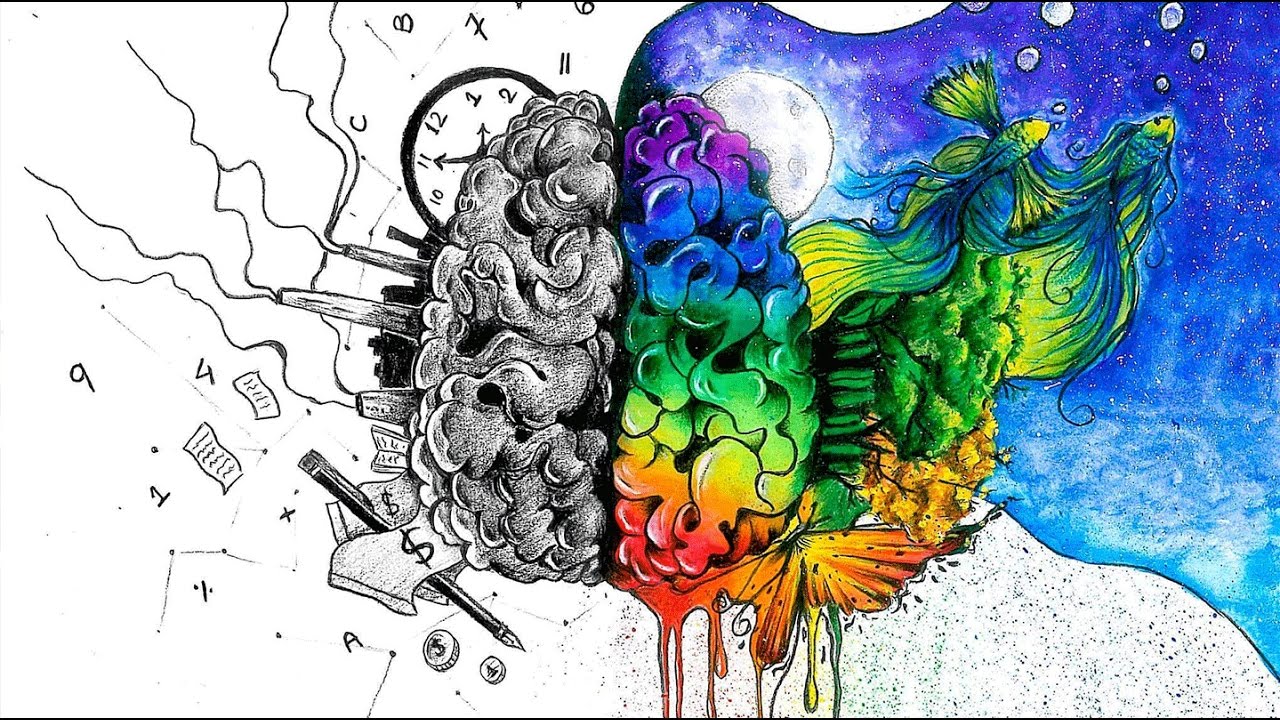
Left Brain/Right Brain

  Image result for left brain right brain

In 1976, Julian Jaynes coined the term “bicameral mind” in his eponymous book The Origin of Consciousness in the Breakdown of the Bicameral Mind.  According to this model, the brain is divided into two rooms—“bi” meaning ‘two,’ and “camera” meaning ‘room.’  (We call our cameras “cameras” because the first camera was a large room, much reduced now to the thin room which is an iPhone connected to the doorless room which is the digital ether.) According to this early research, the left brain was in charge of language and the right of imagery. In his landmark, 2009 book, The Master and His Emissary: The Divided Brain and the Making of the Wester World, author Ian McGilchrist offers a much refined theory, informed by extensive research since 1976, to show that both sides of the brain coordinate in the creation of experience.  With that proviso, we can consider how the predominant aspects of our divided brains function in the learning process.

In general, someone who functions predominantly from the left brain, as illustrated above, tends to construct experience as

Linear—one thing following the other in order
             Analytical and Mental
             Product oriented
             Closed
             Staid
Digital—favoring polar binary opposites, as, for example right or wrong, good or bad.
Numerical—clear, quantifiable order, favoring monetary and business systems
Conventional—according to tradition and popularly accepted values
Rule-bound and Prescriptive
Proscriptive—experience and action outside the parameter of accepted rules prohibited
Limiting—at best, the left brain can work four things in consciousness at a time
Rigid and strict
Dividing and Selective
External
Exclusive
“No”
Denotative—words mean discretely, without nuance
Ego and Superego—a will to power
Conscious
Prose
Boxed in
Guarantees
Fear based and inspired

We cannot live socially or in civilized cultures without these functions.  Some of the benefits of the Left Brain include a sense of security and constancy; organization and focus; and social and familial foundations.  The Left Brain identifies goals and marshals them to completion. Language, itself, functions because of Left Brain tendencies.

The problem comes when it presumes to take control of all the brains functions.  McGilchrist argues that, historically, the Left Brain was the emissary from the larger, the contrasting functions of the Right Brain, whose qualities include these:

Global
Contextual
Intuitive and epiphanic
Body and image based
Process oriented
      Open
      Fluid
Analog—favoring paradox and interweaving
Experimental and creative
Evolutionary and revolutionary
Descriptive
Expansive
Patient and flexible
Coordinating
Internal
Inclusive
“Yes”
Connotative
Id
Subconscious incubation
Dreams
Poetry
Out of the box
Possibility
Love based and inspired

The Right Brain is the repository of all of our history as a species—spatially and temporally.  It connects us in what sometimes feels magical ways. It offers us insight, joy, warning, possibility.

            Here’s an example of the difference between Left-Braining and Right-Braining.  I am an international folkdancer.  Every Wednesday night and on long vacations devoted to this art, we get together—women and men ranging in age from 20 to 100, and sometimes with children, to join hands and enjoy the dances from countries around the world and through time, to music that can be soft and prayerlike, or bawdy and rollicking.  After almost 40 years, I know most of the old dances and need only to hear the first few notes and my body knows the rest.  But there is always a leader, whom the rest of us watch.  If I were to put on the music at home, I would know neither the name of the dance nor which step comes next.  That’s because I have mostly Right-Brained these dances.  And, although I am known for being a “good dancer,” expressive, joyful, knowing how to style—and seem to know all the steps—I don’t.

            On the other hand, I have learned dances to teach others, and these I analyze into their component parts, memorize them, practice them, make and correct my mistakes while replaying videos.  I, in other words, take a Left-Brain approach, to “get it right,” correct others.  We have some master teachers in our folkdance group, who always know the steps, and whom the rest of us use as guides.  Too often, though, they devolve into a Left-Brainy make-wrong mode—conventionalizing, criticizing, scolding. What makes my teaching different from that of most other folkdance teachers, is that I also incorporate images in my teaching: “make believe you’re the Statue of Liberty, raising one hand and tucking in the other”; “make believe you are moving through water.”  This helps others to be expressive, joyful, stylized.  And I don’t scold.

            For me, when I’m at my best, this is an example of optimal coordination between the Left and Right brain.  Unfortunately, as Gilchrist argues so cogently in his book, the Left Brain functions have usurped control to assert the will to power. 

In politics, Left Brain leaders manipulate the voting public and constituencies with fear and rigid values. The traditional classroom, too, favors a Left Brain model. The posts on this blog serve as reminders that we are far larger and have greater capacities than the Left Brain would allow, by itself.  We invite the Right Brain into the mix, and favor

Imagery over plot
Experimentation over right/wrong
Community over leaders
Creativity over tests
Original over linear thinking
Learning over grades
Rainbow over black/white
Shapes over straight lines
Possibility over boredom
Spilling over the edges, like the picture above
Poetry over all
And more…


How are your learning experiences structured? Is there a generative balance of Left Brain/Right Brain in your classroom and in your learning process?


Works Cited:

Cover Art: Left Brain/ Right Brain Image

Text:

Jaynes, Julian. The Origin of Consciousness in the Breakdown of the Bicameral Mind. 
      Boston: Mariner Books, 2000.

McGilchrist, Ian.The Master and His Emissary: The Divided Brain and the Making of the Western
      World,  New Haven: Yale UP, 2009.

Sunday, February 3, 2019

Intentional Fallacies: The Literary Seance

                        Image result for seance

“What does Poe mean?" 


                                                “What is Dickinson saying?”


                                                                        “What’s Shakespeare’s purpose?”


                         “Is that Plath’s intention?”


            You’ve heard it all your life in classrooms: questions that assume to speak for an author, that imply that we can somehow discern what she or he Really meant, that urge that there is some ultimate interpretation that will forever tie up the poem in a bow.  It’s an antique way of speaking about literature—patriarchal, limiting, and false.  It turns the class into a séance: “Put your hands on the table.  We call on you, Will Shakespeare.  Tell us what you want.” And the table trembles under the note-taking that the teacher, as medium, channels from the ghost of William Shakespeare, entering the room.

            Let’s step back a moment to appreciate how intricate the process of literary interpretation is, here analyzed into discrete, although non-definitive steps:

(1)   We identify an experience as coalescing into “object.”
(2)   We reach out to touch it.
(3)   We pick it up. It might be a doorstop.  It might be something to turn into a Christmas tree.  It might be a log for the fire. 
(4)   But we identify it as book.
(5)   We turn it this way and that. What shall we do with it?
(6)   We look at the ink marks.
(7)   We identify a language.  If it is Hebrew, we lay the book down with the ruffly
edges to…What shall we call it?  Our left.
            …
And so on.  All this happens intuitively, speedily for most 21-year-olds.  For a 2-month-old, there will be a preliminary process of gumming, ripping, crumpling, throwing, and growing into a 2-year old—who, by that time, might have learned to assume the culturally-correct book reading position.

            By the time we come to call those marks words on what we discern as page and start to interpret it as poem, an infinite series of sophisticated, enculturated, interpretive choices have been made.  So why is it that we suddenly turn the process into a supernatural mystery, a séance?

            True, we hope that by this time in the 21st century teachers will acknowledge that interpretation is subjective. But they and their students continue to use the discourse of divination and fortune-telling—to the extent that teachers make-wrong any but their own “official version” of what, let’s say, Shakespeare is saying. Why continue to commit this intentional fallacy?

According to Britannica.com, “Intentional fallacy,” is a “term used in 20th-century literary criticism to describe the problem inherent in trying to judge a work of art by assuming the intent or purpose of the artist who created it.” Shakespeare is dead, and his gravestone curses anyone who would exhume his bones.  We have found no personal records discoursing on his plays and poems. You’d have to believe in Shakespearean witches and ghosts to argue your teacher qua medium knows what he meant. Prolific novelist Vladimir Nabokov said never to ask what an author is trying to say—because (s)he already said it.  And poet Robert Frost said “I own the first reading. I’ll take a mortgage on the second.  The rest is up to you.”

             More often that not, when readers, critics, audiences voice an interpretation of my poetry, songs, essays, they offer interpretations that I did not consciously work into my writing.  I find them compelling. I am fascinated by the plasticity of literature, mine and others’, to inspire vastly different, and not infrequently contradictory readings.  And if there isn’t this plasticity, then the piece of work is not a piece of literature.  Creativity (discussed in other posts on this blog) is a process of dipping into that 99% part of our minds—intuitive, universal, visionary—which we share with all other human beings.  Memorable writing dips into the greater mind where we all exist—the better the author, the more intuitive her or his process. That’s why we look into the dictionary—a compendium of shared meanings.

A séance is always a group activity, often orchestrated by either a charlatan magician or an intuitively sensitive actor.  The pointer on the Ouija board does not move without the participants relaxing into their 99% minds, by believing that the process works.  But interpretation is just the Oui (French for yes) ja (German for yes) credulity of the participants—just as interpretation is a process by which we turn marks on an object into lived experience and ideas.

                            Image result for ouija board
And Shakespeare does not exist without us picking up that object and naming it a soliloquy or enacting it in a production.  We are Shakespeare, and it would be more appropriate to ask “How do I interpret these marks on a page?”  “What do I make of this?”  "What do these words mean to me?" When we read, we're looking into a crystal ball: we see ourselves.
                                                           
            Notice the language used in your classrooms and how the teacher becomes the medium at the séance. Report back here.                                 

Saturday, January 26, 2019

Boredom and Creativity

                      Image result for boredom

Cheetos, weed, crack, Coors; Ebay, relationship drama, gossip, meddling; Netflix, YouTube, Instagram; texting, internet surfing, Email; gaming, fantasizing—when we are in what Sober Nation calls “H.A.L.T.” mode (Hungry, Angry, Lonely, Tired), we reach for our fixes. Even more, what Halts us most is the space between this and that—Boredom. Call it tedium, dullness, deadliness, dreariness, monotony, tiresomeness, ennui, world-weariness—it’s the nothing-to-dos, the doldrums, the at-a-losses.  The yawn.  For those who know about creativity, who know about magic and the divine—it’s the door. 

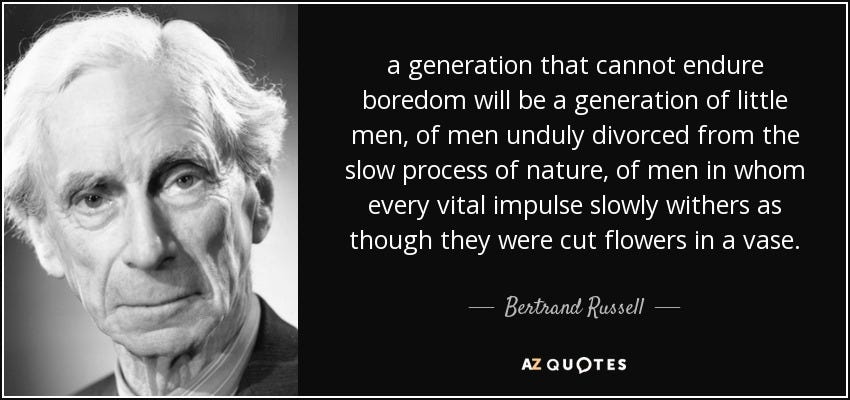
Nothing is the precursor to everything.  It’s the vacuum which Aristotle said “the universe abhors.”  It’s the Possibility in which our great American poet Emily Dickinson dwelt. Artists, mystics, saints, genius mathematicians such as Bertrand Russell (quoted above), and everyday meditators know that there comes a moment of radical nothing. I know, it’s happened to me.  And it is so huge, so unfathomable, that it both terrifies and fills me with awe.  Wow!  It’s the ultimate liberation.  Other’s might call it “God.”  And that makes sense—it’s out of nothing that the divine in myths created everything.


One metaphor for the brain is a series of interlocking gears:


                         Image result for gears

            Boredom is a gear that can’t find a notch in which to settle. The expression spinning your wheels captures the going-nowhere experience of boredom.  Boredom is the unfocused mind spinning, spinning;  scanning, scanning; Scrolling, Scrolling (see post on this blog site); like a desperate gear looking for a notch in which to settle. (It’s me repeating the same thing in this paragraph, not providing you some place new to engage.)

            So it’s a matter of deciding who’s in charge. Who will focus your mind? What matters to me?  Who’s in charge?

            Marketers, software engineers, infomercials—Google, Amazon, YouTube, Apple, Weight-Watchers, among others—create systems that will generate repeat and infinite business.  They are not our friends.  They are money-makers.  Thousands of books, university departments, and training firms teach businesses how to addict us to their products and services—and thus to shell out money to them and to their advertisers.  They manipulate us into believing that they are our saviors—from hunger, anger (and other unpleasant feelings), loneliness, tiredness; and, most of all, Boredom.  Their techniques are to provide novelty, quick fixes, cheap thrills.

            As with every worthwhile avenue of growth and momentum, the first step is to wake up! When I’m bored, when I’m tempted to reach for my fix, I asked myself “What just happened?”  Am I in HALT?  Am I bored?  Can I take care of my huger, my anger, my loneliness, my fatigue in an appropriate way that honors my best self?  If I’m bored, I have an opportunity to enter the great realm of possibility.

(1)   Wake up!
(2)   Name my experience
(3)   If it’s H.A.L.T.: Manage needs in appropriate ways (eat, address emotion, find someone in person, sleep)

If it’s the Angel of Boredom:

(4)          Stop!!!
(5)          Name that addiction
(6)          Don’t give in to the addiction
(7)          Feel the discomfort
(8)          Take ten deep breaths and/or
(9)           Meditate and/or
(10)         Go outside and
(11)         Listen
(12)         Look
(13)         Wait for it
(14)         Wait for it

(15)         Aha!

           The mind knows how to take care of itself, if we let it.  Before long, some worthy idea, some solution to a problem, some creative insight, some generative course of action will occur to you.  You have accessed your Greater Mind—your unconscious where, like a factory of elves, all of your answers are being created and are stored.  For those of you who believe in a divine, the process is to Let Go, and Let God.

            Media Ecology—the study of how, literally, systems Mediate between us and our better selves—helps us to wake up.  Neil Postman, the founder of the discipline, warns us in the title of one of us books, that we are Amusing Ourselves to Death.

            Think of embracing Boredom as

            Giving Yourself Space
            Taking care of what matters
            “Dwelling in Possibility”
            Preparing the way
            Enticing the Muse

            I promise, you will vastly improve your

            Memory
            Creativity
            Energy
            Relationships
            Access to Joy

            When are you bored?  How do you respond?  How can you take hold of your life and use Boredom as a tool for creativity and successes?  How can you, following Bertrand Russell’s image, stop cutting yourself off and get rooted in your own life? 

             Here's a memorable quote from Holiday Mathis's column Your Stars:

             It may seem counterintuitive, but it's the absence of color and light that will be the most stimulating. Blank spaces invigorate your most creative instincts.  (Libra: 3.12.20)

Works Cited:

Art:

Gears: Gears  http://www.udsakron.org/what-we-do/gears-summer-program.aspx

Text:

Dickinson, Emily.  “I dwell in Possibility.” The Poems of Emily Dickinson. Ed. R. W. Franklin. 
Boston: Harvard UP, 1999. #466.

Postman, Neil. Amusing Ourselves to Death. New York: Penguin, 1985.