Showing posts with label writing. Show all posts

Tuesday, April 23, 2019

A New Day for Clichés

                         Image result for cliches


the which, “A New Day,” is a cliché, itself. A cliché is an overused, been-there, done-that, same-old empty expression—even this sentence is filled with them—"been-there,” “done-that,” “same-old”—I could have added other clichés to my descriptors: “shopworn,” “dead metaphor,” “yawns.”  But why bother about them?  (Another cliché.)

            The word cliché is an onomatopoetic reference to the sound made by a stereotyping machine—a printing method that slides a bar back and forth over a paper laid on an inked plate.  Cliché, cliché, cliché. The word “stereotyping,” itself, is a metaphor taken from that process to refer to viewing those who are different from us as if they weren’t unique individuals—same thing, same thing, same thing.  It is a denial of the diversity and changeable nature of life. It inflates our egos at the expense of other human beings. Clichés are an invitation to stop asking questions.  Democracy, humanity, all scientific and creative activities are predicated on asking questions.  Without question, without questions civilization implodes.

            Cliché is defined as any word, phrase, idea, or habit that has lost meaning by careless overuse.  When Shakespeare first coined such phrases as wild goose chase, green-eyed monster,
seen better days, forever and a day, fair play, lie low, and good riddance—they were original and meaningful to his contemporaries.  But most of us in our twenty-first century urban lives never see a goose, even as a Thanksgiving meal, let alone know what a wild goose looks like or what it would mean to chase one.  And how many times have you wished someone to sleep tight?  That expression refers to a time when mattresses were laid atop a series of ropes that were tightened by wooden turners each night.  With our sleep number and digitally managed mattresses, sleep tight no longer makes contemporary sense.

            In stoking stereotypes, prejudices; in shutting down creative and critical thinking; clichés give us a—here comes another cliché—false sense of security—a feeling of certainty, tradition—a common language.  But clichés—like all racial, gender, national, and sexuality stereotyping—are dangerous.  Just because something is familiar and pervasive, doesn’t mean that it means anything, or anything significant.  Consider a slogan created in the 2016 United States presidential election: “Make America Great Again.”  Since it’s been coined (that’s a dead metaphor, too, “coined”—most of our current currency is either paper or digital), this slogan has been slung about to create battle lines between political parties, national regions, and diverse populations within them.  I

            But Make America Great Again, in its divisiveness, is misleading and dangerous.  First, the phrase assumes a particular definition of “great,” a very vague and overinflated (another dead word referring to balloons and tires) term.  Next, it assumes that America has been in—whatever sense you’d like to project—great!  It also assumes that if America was great that somehow it stopped being great.  All of these assumptions are just code for bashing the previous administration and inviting everyone to give into their stereotyping prejudices.

            Clichés provoke school shootings, terrorist attacks, hate crimes, and divert our attention from real issues—such as global warming. So, this business of becoming aware of clichés is not only important, but (another cliché coming) life-and-death crucial.

            I know the temptation, all too well. In my early drafts of my textbook, The Flexible Writer, I incorporated clichés.  Thankfully, my publisher sent out preliminary chapters to professors nationwide, as prospective customers.  I was mortified when they pointed out how many clichés I had used.  I realized that using them was a reflection of my insecurity about writing the book, my need to cozy up to readers, a way to say I’m one of you. Naturally, that was a victim pose, not worthy of someone who was on a mission to help others write authentic, original work.

            So, too, especially as a student writer, you might find yourself using clichés, for a variety of reasons:

(1)   You don’t realize you are
(2)   You’re padding your paper to reach a page quota
(3)   You’re insecure about your writing
(4)   You don’t have the energy to think
(5)   You are hypnotized by clichés

Languages are repositories of history.  As Ludwig Wittgenstein wrote, “to imagine a language means to imagine a form of life.”  It’s nearly impossible to write a phrase without invoking some metaphor that someone created afresh eons ago, but that is dead now.  Think of them as being on a continuum—from Almost New to Boring. 

Rule #1 for a writer, especially a student writer, is Don’t Be Boring. Consider clichés in writing to be bookmarks, placeholders, blank spaces (for a cliché is a blank when it comes to thinking) to be revisited—deleted, rethought, revised and re-envisioned. 

Here are some clichés I harvested from a recent set of student papers.  My yuckiest is in today’s society. The word society can apply to as little as keeping society with oneself, to the multi-billion inhabitants of earth.  It can apply to a group of skinheads as well as a gathering of Quakers.  The word is impossibly broad and uninformative.  My second bleh cliché is in fact. The word fact derives from the Latin facio, which means ‘to make.’ One person’s fact is another person’s question. We make them up until the next more compelling point of view emerges. To modify a claim by appending as a matter of fact shuts down thought and invites all the other dangers of clichés.

 Then there are beck and call, has feelings for, putting women down, what stood out to me, has to do with, at first glance, ranting and raving, keeps a close eye on, something to be said for, in a flash of an eye…

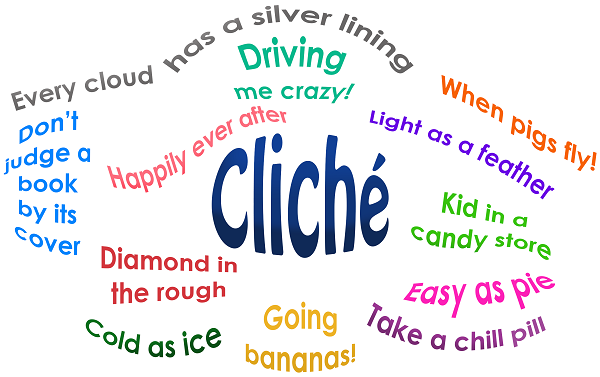
Consider clichés to be signals and opportunities to wake up to language. Become a cliché hunter, especially in your own writing.  Consider the expressions in the art at the top of this post.  Go to the internet, type in clichés, and be amazed. Listen to yourself and others. Name that cliché and then ask questions. 

            Name and avoid clichés. Strive for original, thoughtful, vivid language. To do so is a political and moral act of respect—for oneself and for others.  It is a route to authenticity and civility.  Becauseicanteach.blogspot.com is devoted to identifying clichés in education, specifically, and in language, in general.  Are you, as it were, in?

Looking forward to your observations on and examples of clichés.

Works Cited


Tuesday, March 26, 2019

Story! Not Plod: Don't Be Thorough. Be Deep!

Image result for plod

"Plot is a primitive vulgarity in literature"
~Ayn Rand in Atlas Shrugged.

           To paraphrase or summarize a piece of literature is to attempt to carry the burden of the whole of its mass into an essay.  It’s pure drudgery, trudgery, pain in the, as it were, lower back to write.  It’s boring and a pain in the upper back (and neck) for readers to read.  Paraphrasing and summarizing have been two of the forms of punishment—along with dunce caps, raps on the knuckles, beatings with paddles and switches, and cages—with which teachers have abused students (if only metaphorically). And if teachers are bored reading the results, then, well, it (de)serves them right.

            Early on as a teacher, I vowed to be honest with myself and with my students. I don’t assign boring tasks that result in boring reading.  Paraphrases and summaries are boring.  If they are improvements on the literature, then why have the literature?

            But, but, but, I hear a reader sputtering, We have to know what it’s about. Yes, it surely helps to know that Hamlet’s uncle poisoned Hamlet’s father, and that the play Hamlet is a journey through how Hamlet does or doesn’t cope.  That’s the story of Hamlet.  But we don’t have to know (and here I’m leaving out a two-page summary of the play) every first-this-happens-then-this-happens-then-this-happens-then… detail to cut to Hamlet’s To be, or not to be soliloquy.  We don’t have to eat the whole wedding cake to savor our one (or two) slices.  If we do attempt to eat the whole wedding cake, that sack on the boy’s back becomes a big sack of a belly—we end up not being able to stomach the literature.  We get sluggish, vomitatious, sleepy. (But enough of this extended metaphor.)

            Let’s distinguish story from plot—or what I am fond of calling “plod.”  The story is the two-sentence blurb we read when surfing through Netflix for a new film to watch.  It’s what we tell a fellow student who corners you before a class and asks you (as she hasn’t done the assigned reading) “What’s the story about?”  The process of distilling the story enables you to choose your focus and to read more deeply.

            The plod is the breakfast-to-bed details of first-this-happens-then-this-happens-then-this-happens-then…  It fills up the required number of pages; you can do it while multi-devicing, eating, and (forfend!) driving; and you don’t have to learn or change your mind in any way.  It’s substituting a false sense of thoroughness for depth and originality of thought.

            It’s no wonder that the children’s story character, Mr. Plod, is a policeman.  Assigning plod—woops—plot paraphrase/summary—is to police students: Are you following the teacher’s laws?  Are you thinking what the teacher’s thinking?  Summary sites were created to level the possibility of students actually learning how the mind works, how it might work. They pander to our addictions to games and social media—get this school assignment over-with, so I can get back to my phone.

            Other forms of plod include writing (1) Annotations.  In this exercise, students might quote a sonnet line by line, offering a few remarks—notations—after each.  (2) Breakfast-to-bed. Usually used in not-so-creative first-draft story writing, the student starts by detailing image after dutiful image of what it means for a character to wake up. Unless you’re having your character wake up as a huge insect, as Kafka does in “Metamorphosis,” a startling, and engaging premise, breakfast often leads to another form of plod, (3) Close links. First you wake up, then you brush your teeth, then you… (4) On and On. Attempting to cite every instance of a theme or pattern than you discern in your subject matter. (5+) Other variations include Monday thru Sunday, 1 to 10, and, well, I don’t want to plod through all the plodding possibilities here.  Burdensome to write, plod writing is burdensome to read. Whatever creates a feeling of “oh-no,” Do-I-have-to-plod-through-all-this-one-robotic-step-at-a-time? disappointment in you, as the writer, will create it in the reader.  As soon as I get a whiff of that in a student paper, we’re back to the revision board.

Don’t be thorough—be deep. As viewers might say about a film, “get to the chase.”  For our literary purposes, it’s “get to the story.”
                     Typewriter What is Your Story


Works Cited:


Because I Can Teach Resources:


One Paper Clip: https://becauseicanteach.blogspot.com/2018/05/one-paper-clip-detail-design-
depth.html

Thank you, Brianna Oddo, for alerting me to Ayn Rand's quote!


Thursday, March 21, 2019

Why Write?: Knowing When and How

Image result for why write
In a previous blog, Pyramid of Needs, we considered Abraham Maslow’s hierarchy of why we do as we do in our lives. According to Maslow, these are our priorities: (1) Survival, (2) Security, (3) Power, (4) Love, (5) Communication, (6) Self-Esteem, (7) Self-fulfillment.  If our first priorities are not satisfied, even minimally, then we can’t get to the higher levels of self-esteem and self-fulfillment.  Where we are on the pyramid shows up right away when we are challenged, as for example when we read or write for a class.

In my textbook, The Flexible Writer, I discuss  three main purposes for writing, which I adapted from James Britton’s insights in “Notes on a Working Hypothesis about Writing”: Self-expressive, Interpersonal, Aesthetic.  A given piece of writing may serve some or all of these.  Practicing writers know how to gauge what is appropriate and don’t, for example, write a mostly self-expressive piece when an interpersonal one might be more effective.

Self-expressive

Self-expressive writing satisfies the need for asserting our survival and security needs.  It satisfies the need to be heard and recognized as an individual, despite social pressures.  Through it, we might vent our anger, complain, grieve; exalt, dream, wonder.  This purpose is often fulfilled by the very act of writing, itself, whether or not someone else reads what we’ve written.  Self-expressive writing often takes the form of first-draft diary entries, letters, autobiographies, lyric poems, songs—rants on Facebook, dashed off Tweets and GIFs. Here is a self-expressive draft written by student Samantha Renner:

I am terrified of the idea of war.  All I can think of are those films of houses gutted by bombs, children lying half-naked and dead in the streets, and blood everywhere.  Sometimes at night, I wake up to the sirens from the fire station down the block, and I panic: What if they are not signaling for a fire? What if, somehow, there are planes coming to bomb our town?  This must be just a little of what people must feel who are actually in a war zone.  It’s terrible.

In this paragraph, Samantha expresses her feelings about war.  The self-expressive purpose is fulfilled by the very act of writing. Samantha doesn’t anticipate a reader, and no one has to have read what she has written or respond to it.

            If you find yourself resenting, defending against, or arguing with others when they respond to your writing, it may be because your intention was only self-expressive.  Know when to show your writing to others.  Read the blog post Writer's Wrodeo: Whoas and Wonders to help you to discern where you are with a particular piece of writing.

            Interpersonal

            Interpersonal writing satisfies not only the needs for survival and security, but also those of power, love, and communication.  Through interpersonal writing, we connect, break, or negotiate with a reader, an audience (a word that literally means “those who listen”).  Our anticipated audience may be as far away as a reader in another country or century, whom we may never meet; or as close as ourselves.  Our anticipated audience may be as specific as an instructor or as general as a U.S. citizen.  Our task is to determine our primary audience and how to reach it.

            In interpersonal writing, we try to convince someone else to recognize us, to do something for or with us, to agree with us, or to change her or his ways.  It may take the form of letters, proposals, editorials, business and legal memos, recipes, instructions—or chat threads.  Submissions to teachers are meant to embody what you have learned and to earn a grade. (We will consider specific educational purposes for writing in an upcoming post.)

            The following is an excerpt from an essay Samantha wrote with a predominantly interpersonal purpose: to persuade her audience of her position.

            Before our country declares war on another country, I believe several things should take place:

     (1) There should be an open debate on media between those who are for and those who are against the war.  Debaters should include the parents of draftable people, military personnel, lawmakers, conscientious objectors, and ambassadors from those on whom we might declare the war.

     (2) There should be films of war played on television, the internet, and social media showing the ravages of war, especially on non-military persons.

     (3) There should be a vote taken from the general population.

     (4) There should be an active campaign to ensure that at least 50% of the population votes.

            Samantha’s interpersonal writing invites debate, action, and results.  She uses rhetorical devices (persuasion techniques) such as bulleted points and clear appeals to emotions (as in her evocation of war images).  In a workshop, fellow writers can help her anticipate how others might disagree with her, so that she can head readers off before they can.

            Aesthetic

            At its best, aesthetic writing satisfies the highest levels of needs that Maslow identifies: self-esteem and self-fulfillment.  It assumes that self-expressive and interpersonal needs have been met and attention can be turned toward writing for the sake of elegance, compression, beauty, overall memorability.  If only aesthetics are managed in a particular piece of writing, then it can be superficially entertaining, but it will lack depth. When, for example, your instructor insists on grammatical correctness, but ignores the self-expressive and interpersonal aspects of writing, writing might be more like a Styrofoam cup instead of one made of fine porcelain.

            Aesthetic writing has action, imagery, and dialog.  The diction (choice of words) is compelling.  Aesthetic writing is based in imagery—to reach deeply into the reader’s consciousness.  It is specific.  It is something new. It incorporates the poetic and lyrical techniques, as Dr. Martin Luther King, Jr. does in his “I have a Dream” speech, or William Shakespeare does in Hamlet’s “To be or not to be” soliloquy.

            Here’s is Samantha’s poem, focused with aesthetic strategies:

            When will We Awaken?

     The sirens shriek,
     3:30 in the morning, again.
     Somewhere nearby there is a fire.
     This one will be cooled by ready water.
     The children will be carried
     by people in wet rubber coats.
     What of the shrieking in another place
     where no one will carry the children to safety—
     away from bombs bursting in air
     giving proof through the night    
     that a flag may wave?

     Not only has Samantha expressed her outrage at war, but, in focusing on specific imagery and strategically invoking the “National Anthem,” she’s argued against war.  She fulfills all three major modes of writing: Self-expressive, Interpersonal, and Aesthetic.

            Combinations

            Samantha successfully combined all three modes of writing to satisfy a hierarchy of needs.  Sometimes, it can be hard to separate the aesthetic from the self-expressive and the interpersonal in some work.  And that is devoutly to be wished for—to have all three integrated.

            Ask yourself when you are writing, what need or needs you are predominantly satisfying.  And when it comes to writing workshop, be honest with yourself:

If your purpose is mainly self-expressive, then you will not want anything but approval.  Your purpose will be mainly focused on your own experience.  Ask your readers to refrain from suggestions for revision.

If your purpose is interpersonal, writing workshop will provide you an opportunity to test-run your ideas and to strengthen your chances at better results. Be open, listen, thank your readers for their support and commitment to your writing.

If your purpose is predominantly aesthetic, you might, again, only want approval. You might welcome readers to offer their appreciation for different aspects of your writing style as they manifest in your work.

But if you can combine all three purposes, you will afford yourself a lively and supportive atmosphere for becoming the liveliest writer you can be. 


Works Cited


“Pyramid of Needs.” becauseicanteach.blogspot.com http://becauseicanteach.blogspot.com/2018/03/


Britton, James. “Notes on a Working Hypothesis about Writing.” Prospect and Retrospect: Selected
Essays of James Britton.  Ed. Gordon M. Pradl.  Montclair: Boynton/Cook, 1982.)

Rich, Susanna. The Flexible Writer. Fourth edition. Boston: Allyn/Bacon, 2003.


Tuesday, March 19, 2019

Writers' Wrodeo: Workshop Whoas and Wonders


I know what it’s like to be the bronco.  I was four years old. The child of Hungarian immigrants.  Poor. My parents were separated. I was unable to speak or understand English.  Lonely. Unbelonging.  Helpless.  Defended.

            The kindergarten nun—I didn’t have a way of remembering an English name—had handed out flash cards for us to identify pictures with a word.  Of course, I didn’t, at the time, follow what this game was.  I had just come from being wrestled out of the protection of my coat.  I was hungry.  Why was I being subjected to this?

            All the other children were happily calling out words.  When it came my turn, I crossed my arms over my chest.  Pouted.  And shoved the flashcard away with the back of my hand.  I burst into tears.

            What happened next, I don’t know.  But I learned to speak, write, and read in English.  I have been teaching English, now, for over 40 years. My Hungarian father often bragged that a Hungarian girl was teaching the English English. But I feel helplessness and frustration in some students when I introduce new writing strategies in workshops.  The first round is always the toughest: “It’s my writing!” a student will often say, implying that I am violating her privacy.  “That’s the way I like it,” another will say (implying “hands-off!”).  Or, “You just want me to write the way you want me to write.”  The worst part of that is the implication that I’m being just as arbitrary as teachers who insist on the five-paragraph essay, or simply regurgitations of teacher’s opinions.

            In other blog posts, among them, “Reasons for Writing” and “Damning with Praise,” I offer ways in which to understand workshop dynamics. But the most difficult experience is the defensiveness and ego-attachment we are considering here.  And it often comes from experiences that have little to do with writing, per se, and everything to do with the vulnerabilities that come from the kinds of childhood trauma I described above.  If you are peripheralized in any way, especially because of things that you cannot help—nationality, gender, race, age, sexual-orientation, family, ability, or class—any suggestion that you can grow as a writer might feel like just another personal rejection—“Don’t be you. Be like me.”  If, in addition, you have only had single opportunities to hand in papers for a grade—which would make anyone feel anxious and helpless—then any recommendation for redrafting will raise a feeling of despair.

            I regularly meet now with my own colleagues to workshop my own writing—this post, too, has been vetted by my husband, for example. I’ve made many changes from my first draft, calling on the voices of my fellow writers in my head. My editors offer me suggestions, which  almost always help me to make significant breakthroughs in my work. But in the past, in the hands of workshop leaders that were writers but not teachers, I have walked away in tears.  Especially corrosive are those men who use workshops to court women.  (But that’s for another post.)  Then there are workshops where the leader assumes and maintains power by how she metes out attention and praise.  Cliques form. And we’re right back to feeling like the child who doesn’t belong.

So, if you feel, as I did, like pushing away from the desk and sulking, ask yourself these questions.  Is my teacher a writer? Is my teacher a teacher (as opposed to a writer who needs a job)?  Does this teacher have experience and writers’ skills to offer me? Do I want to learn them? Do I feel like I can grow as a writer?  Do I want to reach more readers?  Or is this about my feeling bad about myself, for other reasons?

If I didn’t watch others around me walk, I might have crawled all my life.  If I didn’t have those tall people holding my hands as I stood for the first time, I wouldn’t have walked.  If I didn’t have other dancers show me the steps and model for me how to make the moves—I wouldn’t be the dancer I am.  So, too, with writing.

And if you can’t learn from what is said directly about your work, learn from what is said about others’ writing.  Learn from the insights that arise in you and that you share.  Trust the process. Always express gratitude for others' care and attention. 

Your ego and fears and anger will be like that bronco bucking, kicking, struggling.  But stay with it.  In time, you will tame your fears and recover from the real insults to your integrity that come from xenophobia (fear of strangers) and prejudice.  And then, oh the places your writing will ride you!


How’s your bronco-bustin’ going?

Image result for happy trails

Works cited:


Sunday, February 17, 2019

The Love of Reading versus Studying: A Continuum

                           Image result for studying

            It used to be flashlights under the covers with comic books—now it’s phones, tablets, E-readers—there is something delicious about wanting to read so much that we sneak it.  I’m not talking about social media, compulsive scrolling, online shopping, gaming, or texting—that doesn’t count as reading—but being eager to return to a book does.
            It would seem that school should inspire the love of learning, as libraries do with clubs and book fairs—but, unfortunately, school ruins reading for most of us.  In this blog post, I want to address this problem and to offer a model to help us recapture our passion for reading, so much so, that we abandon our Netflix, YouTube, and whatever new distractions and addictions have emerged since I posted this essay—because we can’t wait to indulge our love of books.
            On one end of the continuum is self-motivated, indulgent, glorious wanna reading—the kind we talk about with your friends and never seem to see in a class; the kind where we fall in love with an author and scramble to find everything she or he has written. On the other end of the continuum is studying boring gotta textbooks in anticipation of quizzes for get-it-over-with courses and grades.
            But there are some truly fascinating works presented in classes that belong on the love side of the continuum—that are ruined by how they are “taught.”  So, it’s not even so much what is included in classes as how we are harassed into, literally, confronting them.  It is truly tragic to me that, when I ask my students in their senior capstone courses what they love to read, they look at me like deer stunned by high beams in the middle of the night.  It has been so long that anyone cared about their experience of reading—since they felt any passion for reading themselves—that they don’t know how to answer.  Teachers placed themselves between them and books, co-opting, mediating, and grade-quantifying their experience.
First, it’s such a ridiculous expression: “I’m teaching Shakespeare.”  Under one interpretation of the expression, that’s ludicrous.  Can’t teach Shakespeare anything—he’s totally gone.  And teaching conjures in all of us the fear of metaphorically being the dunce shamed in a corner, having our knuckles rapped with a ruler, or having to suffering detention.  I reject the prevailing pedagogical model that favors learning standard information over learning how to appreciate, that favors assessment models over learning. Teaching should be about inspiring, modeling for, and empowering students to create meaningful, and intellectually and emotionally satisfying lives.
Reading was ruined for me, too.  That’s why I can write this. It has taken me years to actually read through a book without taking notes, highlighting, annotating the margins, and memorizing “key” ideas.  It has taken me years to question whether a book is worth reading through, just because it is a published work that someone else required me to read.  It has taken me years to think of books as treasured friends to turn to for relaxation, adventure, illumination. It’s only now that I’ve stopped, as a teacher, thinking of the works I assign to classes as reading chores for myself.
To rehabilitate us all, I don’t give quizzes to police whether students have read our texts.  We develop an atmosphere of commitment and engagement early on and most students come prepared—that is not negotiable. And I certainly don’t give multiple choice tests.  Horrendously, there are some teachers who actually administer quizzes and multiple-choice tests in Creative Writing courses.  Really?!  I have discoursed on this in other posts, but my focus in our classes is not what I want, but what students actually get from their readings. 
I ask first, a show of hands, of those who have read the portions of texts we will be considering that meeting.  Most students are honest, and they know the rest of us will know—given the nature of our discussions—whether they showed up that week.  That’s usually enough embarrassment for them to come prepared. After that, it’s all about making the reading belong to THEM not to me as the arbiter of grades. And my hope is that they will be able to recover from studying and learn how to enjoy the readings.
One of the following questions will often catapult us into our discussions: Did you like reading this?  Why or why not? What caught your attention?  What did it mean to you?  Is this good, engaging writing?  Why or why not?  What questions arose for you? 
Just as a docent will show visitors how to view new, experimental art in a museum, our class is a place where I can model different doorways by which to enter a piece of writing, such as imagery, theme, characterization, structure—but not everyone thinks alike, and not all strategies will resonate with all students.  I don’t require all students to equally engage with all our strategies. 
Even more than discussion with the whole class, my students discuss readings in small groups—that’s nothing new.  But I don’t micromanage the direction these discussions will take with checklists of questions tending toward “approved” responses. We come together after group readings to benefit from the often unique and inspiring insights that emerge from the reading pods.
Here are strategies to remember if we are to pull our readings away from the study end of the continuum back to the love-of-reading end:
Less is more.  Good books deserve rereading and rereading.  What’s my take away this time from these pages?
Don’t be thorough—be deep.  If I try to memorize and retain everything I read in that limited corridor which is my left brain—I’ll drop it all. Best to carry away one idea that matters, and to integrate it.  Otherwise I’ll drop it all after the test and it won’t be available to me after.
Take what you like, and leave the rest. Most teachers would balk at this. My devotion is to inspire—not terrify.
Consider the continuum.  Are you reading or are you studying?  Ask yourself these questions as antidotes: Do I love this reading?  Why or why not?  How is this reading about me, and not about the teacher or the test?  How can I use this reading to find deeper and more satisfying meaning in my life?  How can I integrate this reading into what I already know?  What else could I read along these lines that might be more inspiring?
I invite you, as well, to read the blog post on TRUST—learn to trust yourself, as a reader, despite the environment of distrust that standard education fosters. Will it be on the Test?: Trust and Joy in the Classroom. The love of reading and your passion for literature will return if you make it your own.
I look forward to hearing about your experience of how studying can ruin reading for you. How can and do you nourish your love of reading?

            
                          Image result for reading


Works Cited


Monday, March 24, 2014

Media Freeze: Disavoiding the Void

     It's no surprise that there is such a cult of zombie events, literature, personal styling--what else have we become but our droids' droids?  When I walk around my university, I find so many people just lost to me--talking into their phones (or more scarily, into the air, as they have Star Trek devices in their ears to pick up conversation), thumbing texts, stroking tiny screens. Everywhere, heads bent, backs rounded, hands scrunched into soft fists. In the past, people around campus and I made eye contact, at least mumbled a greeting, held doors open for each other, or had to learn something about the need to avoid contact. I was able to ambush people (especially strangers) with compliments--brighten our day. But I can't go up to a speed-texter and say: "Excuse me.  I need a bit of human contact.  I like your phone case."  That would be icky.
   
    Smart (hm) phones, television, video games, even the microwave (my student Graig taught me this)--make us dependent on mediated experiences.  There's much more to say on this.  For now, I'd like to report on three things we're doing about it.

     CLASS AS SACRED SPACE:  First, obviously, no live phones during class.  But, further, no live phones in the classroom, either before or after class--and none during breaks. This freaks some students out.  I have actually had someone drop a class because of this--and this wasn't a mother with primary care for six children and three aging parents and in-laws.  It's a measure of the addiction, that someone can't take an hour or three off from the need to be absent.  What happens?  Our class becomes (take this in a non-sectarian spirit) a sacred--a safe space.  Even before class starts--without the opportunity to la-la into the ether--students get to know each other--they talk, work on the projects, check in about readings, make plans to share books.  They might actually pay attention to their hunger and eat. They come home to themselves and each other!

     FAVOR PAPER:  Screens make us, ironically, absent to each other. It's not the only thing--yesterday, a lovely student, who surely was listening, trailed off into doodling.  We talked about it in class-that we felt that he wasn't fully present. In any case, I don't allow students to use any but paper media for in-class readings. I read my Shakespeare plays on my Kindle, but lug my completed to class.  It's just a different experience to thumb paper. And there is something very moving about seeing students read from the same page. (Another blog.)
 
     MEDIA FREEZE:  I make a throwdown to conduct a media freeze: Identify your media addiction--anything that you use to avoid the voids in life (more on that in another blog).  The usual ones, these days, include texting, Tweeting, Facebooking, Emailing, television, ear-bud traffic, video games. We know what makes us users--what keeps us from doing or being what we truly want--the thing without which we don't think we could survive.  As I mentioned above, Graig, an avid culinary artist, realized that he uses the microwave instead of taking the time to cook.  And ah, the difference between a nuked and a slow-baked potato!  I hope Graig responds to this blog as to how he extended his media freeze.
     Then set a duration of time to shutdown on that medium.  Take notes on what happens.  Keep your commitment.

       It's years now, that my husband and I shut off the internet between midnight Saturday and midnight Sunday. I read a lot on Sundays, cook special meals, we have long schmoozy conversations and actually notice if one of us had some hair work.

     But I'm a droid to my droid. I have spent hours on my phone playing Words With Friends--actually sitting on the couch with someone while we play each other.  No eye contact there, although at least we can pass the pistachio bowl to each other.  So I wrote to my WWF buddies--I'm taking a sabbatical.  That was 4:00 AM.

     It's 5:20 AM. Surprise! Surprise! I have made a commitment NOT to check out my games, NOT anticipate my next moves as I wait for my friends to make theirs, NOT to check out on myself.

     What's filling the void?  I started this blog. Hope you'll respond with your story.

© 2014 Susanna Rich


Saturday, March 8, 2014

"Basically" Means "Generally": How Not to Say What You Mean

BASICALLY:
HOW NOT TO SAY WHAT YOU MEAN
(The Lyrics)

INDUCTION:

♫Words would be very useful
for school and love and work,
if only they would mean
what they mean.

♫I have started (no, not started
but do) to wonder
(no, not wonder but know)—
how we turn words inside out
like (over)sensitive laundry.

CHORUS:

♫Basically means “generally,”
Little bit means “a lot.”
How Are You? means
“I wanna tell you ‘bout me
so spare me your TMI.”

I.                   BASICALLY

♫Basically means I don’t know
what to say next.
Once I’ve said “basically”
well, sorta, who can argue against‘t?

♫I had a five-minute presentation
on Ophelia to do,
but Ophelia I didn’t feel ya
so basically I said basically
87 times:

♫“Basically, Ophelia was basically this girl.
Basically, Ophelia was ditched.
Basically, Ophelia was basically a character
in William Shakespeare’s basically Hamlet.”

CHORUS

♫Basically means “generally,”
Little bit means “a lot.”
How Are You? means
“I wanna tell you ‘bout me
so spare me your TMI.”

II.              LITTLE BIT

Verse:

♫Say a little bit when you’re afraid
to say that it’s “a lot”
or when your family, lover, money
is no one else’s biz.

♫The text buzzes in “Did he ____ you?”
or “Did you ______him?”
“Would you like to ______ with me?”
Or “Did you __________ with _______?”

♫Thumb back “I’m a LB mad, LB broke,
LB bad, LB hurt,
LB in love with someone else
and LB—pregnant.”

CHORUS

♫Basically means “generally,”
Little bit means “a lot.”
How Are You? means
“I wanna tell you ‘bout me
so spare me your TMI.”
III.             YOU, YOU, YOU

My very fave is the use
of second person point of view,
when you really means I—
all that you and your is you
being your own invisible friend.

♫When you’re afraid to own up to
your own experience
or commit to what you say,
it’s more polite to say you, you, you
than me, myself, mine, and I.

CHORUS

♫Basically means “generally,”
Little bit means “a lot.”
How Are You? means
“I wanna tell you ‘bout me
so spare me your TMI.”
 
DEDUCTION:

♫Pacifiers and qualifiers
and clearers of the throat,
here’s more glossary of what
to say instead of what you mean:

♫Why not? means “Thank you, no”
and “I wish you hadn’t asked.”
Sure means “I doubt it”
and It’s Okay means “it’s not.”

♫Let’s come clean and stop
prevaricating—
turn right side out not in.
Words aren’t (over)sensitive laundry.

♫And double negatives
aren’t always positive—
“no never nothing not.”
You say “double positives are never negative,”
and I say yeah, yeah.

CHORUS

♫Basically means “generally,”
Little bit means “a lot.”
How Are You? means
“I wanna tell you ‘bout me
so spare me your TMI.”


***
                       
              WHAT WORDS DO YOU USE TO DODGE SAYING WHAT YOU MEAN?


 Name your dissembling, demurring words, calibrate how often you say them in a day, practice eliminating them, leave a comment.


© 2014 Susanna Rich