Tuesday, April 23, 2019

A New Day for Clichés

                         Image result for cliches


the which, “A New Day,” is a cliché, itself. A cliché is an overused, been-there, done-that, same-old empty expression—even this sentence is filled with them—"been-there,” “done-that,” “same-old”—I could have added other clichés to my descriptors: “shopworn,” “dead metaphor,” “yawns.”  But why bother about them?  (Another cliché.)

            The word cliché is an onomatopoetic reference to the sound made by a stereotyping machine—a printing method that slides a bar back and forth over a paper laid on an inked plate.  Cliché, cliché, cliché. The word “stereotyping,” itself, is a metaphor taken from that process to refer to viewing those who are different from us as if they weren’t unique individuals—same thing, same thing, same thing.  It is a denial of the diversity and changeable nature of life. It inflates our egos at the expense of other human beings. Clichés are an invitation to stop asking questions.  Democracy, humanity, all scientific and creative activities are predicated on asking questions.  Without question, without questions civilization implodes.

            Cliché is defined as any word, phrase, idea, or habit that has lost meaning by careless overuse.  When Shakespeare first coined such phrases as wild goose chase, green-eyed monster,
seen better days, forever and a day, fair play, lie low, and good riddance—they were original and meaningful to his contemporaries.  But most of us in our twenty-first century urban lives never see a goose, even as a Thanksgiving meal, let alone know what a wild goose looks like or what it would mean to chase one.  And how many times have you wished someone to sleep tight?  That expression refers to a time when mattresses were laid atop a series of ropes that were tightened by wooden turners each night.  With our sleep number and digitally managed mattresses, sleep tight no longer makes contemporary sense.

            In stoking stereotypes, prejudices; in shutting down creative and critical thinking; clichés give us a—here comes another cliché—false sense of security—a feeling of certainty, tradition—a common language.  But clichés—like all racial, gender, national, and sexuality stereotyping—are dangerous.  Just because something is familiar and pervasive, doesn’t mean that it means anything, or anything significant.  Consider a slogan created in the 2016 United States presidential election: “Make America Great Again.”  Since it’s been coined (that’s a dead metaphor, too, “coined”—most of our current currency is either paper or digital), this slogan has been slung about to create battle lines between political parties, national regions, and diverse populations within them.  I

            But Make America Great Again, in its divisiveness, is misleading and dangerous.  First, the phrase assumes a particular definition of “great,” a very vague and overinflated (another dead word referring to balloons and tires) term.  Next, it assumes that America has been in—whatever sense you’d like to project—great!  It also assumes that if America was great that somehow it stopped being great.  All of these assumptions are just code for bashing the previous administration and inviting everyone to give into their stereotyping prejudices.

            Clichés provoke school shootings, terrorist attacks, hate crimes, and divert our attention from real issues—such as global warming. So, this business of becoming aware of clichés is not only important, but (another cliché coming) life-and-death crucial.

            I know the temptation, all too well. In my early drafts of my textbook, The Flexible Writer, I incorporated clichés.  Thankfully, my publisher sent out preliminary chapters to professors nationwide, as prospective customers.  I was mortified when they pointed out how many clichés I had used.  I realized that using them was a reflection of my insecurity about writing the book, my need to cozy up to readers, a way to say I’m one of you. Naturally, that was a victim pose, not worthy of someone who was on a mission to help others write authentic, original work.

            So, too, especially as a student writer, you might find yourself using clichés, for a variety of reasons:

(1)   You don’t realize you are
(2)   You’re padding your paper to reach a page quota
(3)   You’re insecure about your writing
(4)   You don’t have the energy to think
(5)   You are hypnotized by clichés

Languages are repositories of history.  As Ludwig Wittgenstein wrote, “to imagine a language means to imagine a form of life.”  It’s nearly impossible to write a phrase without invoking some metaphor that someone created afresh eons ago, but that is dead now.  Think of them as being on a continuum—from Almost New to Boring. 

Rule #1 for a writer, especially a student writer, is Don’t Be Boring. Consider clichés in writing to be bookmarks, placeholders, blank spaces (for a cliché is a blank when it comes to thinking) to be revisited—deleted, rethought, revised and re-envisioned. 

Here are some clichés I harvested from a recent set of student papers.  My yuckiest is in today’s society. The word society can apply to as little as keeping society with oneself, to the multi-billion inhabitants of earth.  It can apply to a group of skinheads as well as a gathering of Quakers.  The word is impossibly broad and uninformative.  My second bleh cliché is in fact. The word fact derives from the Latin facio, which means ‘to make.’ One person’s fact is another person’s question. We make them up until the next more compelling point of view emerges. To modify a claim by appending as a matter of fact shuts down thought and invites all the other dangers of clichés.

 Then there are beck and call, has feelings for, putting women down, what stood out to me, has to do with, at first glance, ranting and raving, keeps a close eye on, something to be said for, in a flash of an eye…

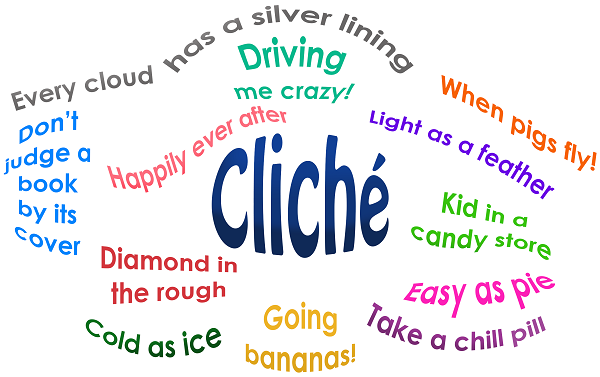
Consider clichés to be signals and opportunities to wake up to language. Become a cliché hunter, especially in your own writing.  Consider the expressions in the art at the top of this post.  Go to the internet, type in clichés, and be amazed. Listen to yourself and others. Name that cliché and then ask questions. 

            Name and avoid clichés. Strive for original, thoughtful, vivid language. To do so is a political and moral act of respect—for oneself and for others.  It is a route to authenticity and civility.  Becauseicanteach.blogspot.com is devoted to identifying clichés in education, specifically, and in language, in general.  Are you, as it were, in?

Looking forward to your observations on and examples of clichés.

Works Cited


Tuesday, April 16, 2019

Grade Junkie Rehab: Benefit versus Credit


GRADE JUNKIE REHAB

           Student writer Orella Chichester remarked, “I’m tired of writing papers for the way teachers will grade them.”  Another student, Arianne Andrew phrased it as “I’m tired of writing papers so that teachers will have something to grade.”  Yet how many times has a student fairly accosted me terrified that they received an A- instead of an A on an essay?  How many times have you, as a student, focused more on a grade than what you were or could be learning?
           
            Especially in our capitalist economies, grades are money.  Just as payment results in a credit to your bank account, grades are credits in your academic bank account.  Just as you earn money, you earn grades.  Just as money is numerical and digitizable, so, too are grades.  Let us make a distinction, though, between what is a benefit to us and what merely earns us credit. Consider these definitions and word origins:

Benefit: advantage; a gift; a public performance for a charitable cause.  From the Latin ‘to do good’.  Used as “Benefit of clergy,” “Benefit of the doubt,” “For the benefit of the community”

Credit: delay of monetary payment, money submitted, acknowledgment/praise of contribution, belief in.  Used as “credit where credit is due,” “give someone credit for,” “credit for actions.” From the Latin ‘to believe in or to trust.’

            When I was an undergraduate, I went through some difficult semesters—dysfunctional family, relationship crazies, financial challenges.  Instead of reading Poe’s “The Raven,” for my American Literature class, I read Antoine de Saint-Exupéry’s The Little Prince—a book I needed to shore up my psychic energy and come home to myself.  I walked into the exam for that class, sat down to questions I couldn’t answer, and asked the professor if we could talk outside.  I told him that I was unprepared and that it would be dishonest for me to respond to the exam as if I were.  He thanked me for my frankness, that he was glad that I had read what I needed to read, and said that he would just issue me a “C” for the test.  That was a gift to me, a benefit. That’s the best grade response I’ve ever had—beyond my hundreds of “A’s.”  I was focused on what would benefit me, and not for chasing a grade for credit.  I have and continue to develop a successful career as a professor, writer, and performer—in great part because my professor stepped out the numbers game and acknowledged that I had taken care to read what would benefit me.

            I now say to students “Let what we are doing in this class be so important and beneficial to you that you would accept a 'C,' rather than drop.”  The irony is, of course, that the more we focus on substance, learning, exploration, growing, the more likely we are, in the end, to earn the “A,” but the “A” and the hope of it no longer traps us—so that we can’t wait to graduate;  the “A” no longer holds us in its thrall, and our efforts to rock climb up to them no longer bedevils our lives.

            In our digital age, students are reduced to ID#s, grades, and bursar receipts.  Schools have become factory businesses squeezing students through the process. And how foolish it is that sites such as “Rate My Professor” consider “easiness” to be a good grade.

            To worry about grades and credits is to give our sense of self-respect over to the whims of others—to only believe in ourselves, as the origin of “credit” implies, when someone else “credits”—believes—in us.  It hurts me when I offer an exciting event for us to share as a class--like a play, museum visit, or field trip--and all a student asks is whether it will affect his grade if he skips it.  It hurts me when students ask for extra credit activities, instead of ways to expand their reading, writing, and performing experiences.

            This habit of caring more about credit than benefit is sometimes insidious in my life. Consider the Fitbitch. (Thank you, songwriting friend Morellen MacLeish for so renaming the Fitbit watches we wear). There are times when I lose sight of how the record-keeping it offers becomes more important than the health benefits of, let’s say, my daily physical exercise.  I get stressed out (I admit it), that I haven’t reached my daily quota of steps, or that I’m not reaching my weight goals.  The more I stress, the more onerous the exercise becomes and the more I stuff my face in response.  In short, I give my power of self-respect over to an impersonal, commercial device.  Really?!

            So, I remind myself to focus more on benefit, not credit.  Not how far have I walked, but how does the air feel, have the endorphins kicked in, how many ideas volunteer themselves to me as I swing my arms and legs.  Yes, I’m caught up in the credit mill as much as anyone else, but it no longer makes my life, as the rehab folks would put it, “unmanageable.”

Why am I doing this?  What are the intrinsic, real-life benefits?  This applies, here, too: I wrote this post because loving my students gives my life with meaning and joy.  I wrote this post to commit to living more authentically, myself.

Finally, in school, instead of focusing on credits and grades, ask yourself: “What am I learning?”  “How can I grow?”  “How does this amplify my life and self-respect?”  “How can I benefit in a real, lasting way?”  Ask yourself, following our addict metaphor, “Is this professor nurturing me, or is this professor a pusher?”


Wednesday, April 10, 2019

What the Heck Kind of Question is That?


Image result for what kind of question is that

             
            A question, by its very nature, invites or assumes responses.  That is why questions are such powerful tools for learning and developing ideas. By asking questions, we enhance the speed, quality, and quantity of our learning.  But not all questions are alike: the better our questions, the better the answers.

            Questions are often triggered by the wh words: who, what when, where, why, and how.  Yes, and how.  Originally, how was spelled and pronounced whow.  Questions can also start with words such as do, can, are, is, were, if, and has, but, as you will soon see, questions triggered by these words do not generate quite the same quality of responses as the wh words do.

            To effectively ask and field questions, let’s distinguish several kinds:

(1) Good questions
                        (2) Key questions
                        (3) Unfair questions
                        (4) Yes/No questions
                        (5) One-answer questions
                        (6) Rhetorical questions

Good Questions

            “Why are our hearts on the left instead of the right side of our human bodies?”  “Why do supermarkets place toothbrushes at adult eye level and not alphabetize soup cans?”  “How do Christians argue for the existence of God?” “Why do some people become alcoholics?” “How can we save the ozone layer?”  “What might cure Alzheimer’s disease?” “What happened to Uncle Frank so that no one in the family talks about him?”  These are examples of good questions.  Students of language notice that good questions tend to

ü  Respond to an important human need
ü  Are focused and specific
ü  Promote thought
ü  May question popular beliefs
ü  Invite multiple, often conflicting answers
ü  Lead to other questions
ü  Suggest how they might be answered
ü  Lead to good answers
ü  Elicit an aha response
ü  May cause strong emotional responses
ü  May meet with resistance
ü  Can lead to collaborative work for answers
ü  Make us respond with “That’s a good question!”

            For example the question “How might we preserve the ozone layer?” is a good question because it responds to an important human need—to health of planet earth.  The question makes us think, has more than one answer, and leads to other questions about the environment.  The question has led to good answers by people who have collaboratively pursued answers to the question.  It isn’t a trick or unfair question.  It leads people to say, That’s a good question. Whether in a classroom, lab, conference room, assembly, or family table, good questions generate lively discussions and promote inspiring challenges.

Key Questions

            The key question driving this post is “What the heck kind of question is that?”  If we were to formulate key questions for the Bible or the Koran, they might be “Who is God?” and “How can we best serve God?”  Whether or not questions are explicitly posed by an author, as readers, formulating key questions for the text will help us to read more deeply.  For the most effective texts, the key questions are the good questions.  When the good question is not explicitly posed, here are some ways to formulate them for what we read:

ü  Posit a point of view of the author
ü  Identify a purpose for why the author might be writing
ü  Choose what seems to be an important purpose
ü  Formulate this purpose as a wh question

            As a writer, articulate your own sense of why you are writing a particular piece. Ask yourself these questions:

ü  Why am I writing this?
ü  What do I hope to discover in my writing process?
ü  Who am I addressing as my ideal reader?

I find that whenever I am at a stopping point in a particular piece of writing,
I turn my most recent sentence into a question to relaunch my flow.  So, for example, I
will turn my previous sentence into a question:  “If I come to a stopping point in a particular piece of writing, how might I relaunch my flow?”

Unfair Questions

            “Are you still beating your dog?” “What’s the difference between a duck?” “How come someone says they saw you did it?” “You don’t want another piece of my pie, do you?” “What is it like to be blown up by a bomb?”  These and other such questions are unfair because they

ü  Assume something illegitimately
ü  Are meant to trick responders
ü  Often exact only one answer
ü  May be unanswerable
ü  Antagonize and confront
ü  Lead or manipulate

          For example, the question “Are you still beating your dog?” is unfair because
it assumes that you beat your dog in the first place.  You can’t win.  If you say “Yes,” then you are admit to beating your dog.  If you say, “No,” then you still admit to having beaten your dog.  The question is confrontational and antagonistic.  In a
court of law, the opposing counsel would object that it is a “leading question.” A fairer
approach would be to first ask, “Have you ever beaten your dog?” 

            In an earlier blog, “Martha and Mary,” I had originally asked an unfair question:
“How are your teachers more Martha than Mary?”  That assumed that your teachers were more Martha and Mary.  When a responder pointed out it was a leading question, I revised it to “Are your teachers more Martha or Mary?”  
 
            Some questions might be unfair because of the context in which they are asked.
For example, it could be unfair and embarrassing to ask a person, “Is that a new hair dye?” at a formal dinner.  But it can be entirely appropriate for a hairdresser to ask this question of a client in the salon. 

            How you phrase a question is crucial.  The question “What happened to
Uncle Frank?” may be a good question, whereas “What did you do to Uncle Frank?”
is not.  The question “What’s the difference between a duck?” is nonsensical.  But when comedian Grouch Marx asks it, the question isn’t unfair—it’s funny.

Yes/No Questions

            “Is there an afterlife?” “Have you gone to the store?” “Are there moons around
Jupiter?” “Will there be enough ozone layer left at the end of the twenty-first century?” “Should there be an extra microphone for the event?” “Can you loan me some money?”  Such questions are yes/no questions because they invite just that—yes or no.  They

ü  Begin with some form of the words is, can, do, has, could/would/should,
or will
ü  Do not invite discussion or collaboration
ü  Limit the range of acceptable responses
ü  May be too general
ü  Can be unfair, given the context

One-Answer Questions

            “How much is 2 + 2 in the decimal system?” “What was the cause of the Civil
in America?” “Who is the main character in Chaucer’s Canterbury Tales?” “What
is the most important trait of a responsible thinker?” “Would any sane person ever
want to kill an innocent child?”  Or, my favorite question to avoid asking students: “What is the main point of this text?” Such one-answer questions

ü  Assume there is only one right answer
ü  Occur most often in courses focused on information, not thinking
ü  Create a guessing-game atmosphere
ü  Can be satisfying to answer “right,” embarrassing to answer “wrong”
ü  May create corrosive competition
ü  May preclude questioning the question’s validity

            For example, the question “What as the cause of the Civil War in America?” assumes, by the use of the word the, that there was one and only one cause of the war.  Similarly,  the question “What is the main point?” may shut down creative and critical thinking. If the questions were posed by a teacher in a class, it could create a “guess what the teacher’s thinking” game. Some students would settle for guessing, others might compete to be the first to say.  Students who don’t want to play, might give up, feel defeated, retreat into boredom, and sneak their phones.

Rhetorical Questions

     “Would you starve the children?” “How many people lost their lives to overdose?” “What more could we have done to save them?”  Sometimes answers to such questions are meant to be so obvious—No, countless, nothing (respectively)—that the questions are not meant to be answered.  They assume a particular answer and are used to affirm agreement.

            If a question is not a request for an answer but a strategy to persuade an audience of a predictable answer and point, it is called a rhetorical question (as the word rhetorical means “meant to persuade”). Rhetorical questions

ü  State, don’t ask
ü  Are often used in rousing speeches and texts
ü  Are meant to impress
ü  Make a point without stating it
ü  Imply one acceptable answer
ü  Preclude an answer
ü  Manipulate

            Notice that context—purpose and audience—determines whether a question is rhetorical.  A villain might ask “Would you starve the children?” as a request for an accomplice to do so.  A writer seeking statistics to support an argument for research on drug-use is not merely posing a bemoaning rhetorical question when asking “How many have died in this epidemic?” A Red Cross volunteer asking, “What more could we have done to save them?” is posing a good question, not merely a rhetorical one.

Explore Questions

            In your classes, notice what kinds of questions are favored in class, and in assessment instruments such as essays and tests.  Learn to discern what the heck kinds of questions your teachers are asking and, if they are not asking good questions, how you might turn discussions to asking them, yourself.  Here are some procedures you might take:

1.     Remind yourself: The only dumb question is the one not asked.
2.     Use the wh words: Who, What, When, Where, Why, (W)how
3.     Analyze select questions by asking
a.      What the heck kind of question is this? Good, key, unfair,
            yes/no, one-answer, rhetorical, undetermined?
b.     What kind of response does this question anticipate?
c.      How could I revise this question into a good question?
4.     Formulate key questions for authors and in your own writing
5.     Practice answering anticipated questions
6.     Ask questions throughout your learning and writing process
7.     Repeat for questions in other important areas of your life: family, relationships, financial, spiritual, professional, et al.


Works Cited:


Wednesday, April 3, 2019

"Can I Ask You a Question?": Power and Dominance in the Classroom

Image result for ask a question

            “Can I ask you a question?” students new to me ask.  I’m fond of answering (1) “You just did!” (pa dum da); and, (2) “Of course not! I’m your teacher.”  Blinks and winks. No one has ever questioned this question before.

            It troubles me, not only because we have become so unaware of our language (a topic addressed in other posts), but because it gives me, as the teacher, an additional layer of power and implicit dominance, that is untoward: A student has not only a right but a responsibility to himself, his teacher, and his classmates to ask questions.  I would place “Can I ask you a question?” on the left side of the power continuum, what I’ll call the “left-behind” side, where the student has the least amount of power (right above cowering silence).  For this post, we will focus on the student’s point of view.  Here’s the continuum:

                                                             Student Power

Silence   Can I ask?                                Discovery              You Can’t Teach Me   Silence

            On the other end of this continuum—what I’ll call the “I’m right” extreme is hostile silence, falling asleep, and any of the rude behaviors with which I regale you in The Rude Student.  Right next to that is You-Can’t-Teach behavior that attempts to wrest power from the teacher: statements and questions that are meant to establish the teacher’s limitations and to assume dominance over her. The student in this mode displays showing off behavior: bringing in topics and angles on the discussion in order to distract attention from the general proceedings in the class and onto herself.  We might call this being “The Devil’s Advocate,” which might, without the will-to-power, invoke the fulcrum Discovery mode. But too often, The Devil’s Advocate is challenging the teacher, not ideas.  This bravado is meant to hide a deep-seated feeling of inadequacy, a translation of the fear of the new, resistance to what might feel like a submission to learning something that she didn’t know before.  Another manifestation of this is the student who dismisses new ideas with such declarations as "I don't get it!"--meaning "it's not worth getting.  You're wasting my time." Whereas on the left side of the continuum the student is mired in inadequacy, on the other end the student is fighting to deny it.  On the left-behind side we have untoward submission, on the right, untoward dominance.  

            In the beginning of my teaching career, when I was the director of a developmental writing program—creating and coordinating courses in which students initially felt stigmatized as unbelonging dummies—I committed myself to notice and to diffuse power struggles in the classroom—to be awake to these dynamics and to replace them with, what all the Because I Can Teach posts assume, learning environments that are respectful, energizing, and geared toward mutual creation and discovery of new ideas and skills.

            So, the fulcrum, the middle of our continuum, is what I call the “Discovery” mode—not even the “Balance,” as that assumes a see-saw between “Left-Behind” and “I’m-Right.”  In this mode, students relax their fearful defensiveness to become active creators of knowledge in the classroom.  Questions and ideas flow freely.  Since there is no sense of “I’m better than you” in either direction, we appreciate each other’s contributions and revel in how we, in each meeting, become renewed.  To facilitate this, I model new ways of seeing and doing, and then release students to working with each other.  Ideally, they will hardly notice me floating between groups, so engrossed they are in their deliberations.

            I often say, “If I haven’t learned something new in a class meeting, then it wasn’t a good class.”  It means I repressed my students in some way, asserted dominance in a way I abhor—squelching their development.  On the other hand, it is also my devotion to notice when a student attempts to assume that position of dominance, which is so corrosive to group dynamics.  To help this student, who, in many ways, is less well off than the Left-Behind, find a way to new learning and legitimate power. Hence this blog post.

            And, yes, there are classes where the teacher is faltering—more interested in asserting dominance, hiding his own sense of inadequacy.  How can we, as students in such an environment, look for a way to turn it around for ourselves?  How can we make our time in such a situation an opportunity instead of a grind?  (For one, we can watch how the dynamics play out, as I am doing here.) 

            How are you in the classroom?  Where do you place on the continuum of power? How can you get off the see-saw to renew yourself?  What happens when you ask yourself, “What new, beneficial thing can I learn here, regardless?”  

           
Works Cited:

Because I Can Teach Link: 

             The Rude Student

Tuesday, March 26, 2019

Story! Not Plod: Don't Be Thorough. Be Deep!

Image result for plod

"Plot is a primitive vulgarity in literature"
~Ayn Rand in Atlas Shrugged.

           To paraphrase or summarize a piece of literature is to attempt to carry the burden of the whole of its mass into an essay.  It’s pure drudgery, trudgery, pain in the, as it were, lower back to write.  It’s boring and a pain in the upper back (and neck) for readers to read.  Paraphrasing and summarizing have been two of the forms of punishment—along with dunce caps, raps on the knuckles, beatings with paddles and switches, and cages—with which teachers have abused students (if only metaphorically). And if teachers are bored reading the results, then, well, it (de)serves them right.

            Early on as a teacher, I vowed to be honest with myself and with my students. I don’t assign boring tasks that result in boring reading.  Paraphrases and summaries are boring.  If they are improvements on the literature, then why have the literature?

            But, but, but, I hear a reader sputtering, We have to know what it’s about. Yes, it surely helps to know that Hamlet’s uncle poisoned Hamlet’s father, and that the play Hamlet is a journey through how Hamlet does or doesn’t cope.  That’s the story of Hamlet.  But we don’t have to know (and here I’m leaving out a two-page summary of the play) every first-this-happens-then-this-happens-then-this-happens-then… detail to cut to Hamlet’s To be, or not to be soliloquy.  We don’t have to eat the whole wedding cake to savor our one (or two) slices.  If we do attempt to eat the whole wedding cake, that sack on the boy’s back becomes a big sack of a belly—we end up not being able to stomach the literature.  We get sluggish, vomitatious, sleepy. (But enough of this extended metaphor.)

            Let’s distinguish story from plot—or what I am fond of calling “plod.”  The story is the two-sentence blurb we read when surfing through Netflix for a new film to watch.  It’s what we tell a fellow student who corners you before a class and asks you (as she hasn’t done the assigned reading) “What’s the story about?”  The process of distilling the story enables you to choose your focus and to read more deeply.

            The plod is the breakfast-to-bed details of first-this-happens-then-this-happens-then-this-happens-then…  It fills up the required number of pages; you can do it while multi-devicing, eating, and (forfend!) driving; and you don’t have to learn or change your mind in any way.  It’s substituting a false sense of thoroughness for depth and originality of thought.

            It’s no wonder that the children’s story character, Mr. Plod, is a policeman.  Assigning plod—woops—plot paraphrase/summary—is to police students: Are you following the teacher’s laws?  Are you thinking what the teacher’s thinking?  Summary sites were created to level the possibility of students actually learning how the mind works, how it might work. They pander to our addictions to games and social media—get this school assignment over-with, so I can get back to my phone.

            Other forms of plod include writing (1) Annotations.  In this exercise, students might quote a sonnet line by line, offering a few remarks—notations—after each.  (2) Breakfast-to-bed. Usually used in not-so-creative first-draft story writing, the student starts by detailing image after dutiful image of what it means for a character to wake up. Unless you’re having your character wake up as a huge insect, as Kafka does in “Metamorphosis,” a startling, and engaging premise, breakfast often leads to another form of plod, (3) Close links. First you wake up, then you brush your teeth, then you… (4) On and On. Attempting to cite every instance of a theme or pattern than you discern in your subject matter. (5+) Other variations include Monday thru Sunday, 1 to 10, and, well, I don’t want to plod through all the plodding possibilities here.  Burdensome to write, plod writing is burdensome to read. Whatever creates a feeling of “oh-no,” Do-I-have-to-plod-through-all-this-one-robotic-step-at-a-time? disappointment in you, as the writer, will create it in the reader.  As soon as I get a whiff of that in a student paper, we’re back to the revision board.

Don’t be thorough—be deep. As viewers might say about a film, “get to the chase.”  For our literary purposes, it’s “get to the story.”
                     Typewriter What is Your Story


Works Cited:


Because I Can Teach Resources:


One Paper Clip: https://becauseicanteach.blogspot.com/2018/05/one-paper-clip-detail-design-
depth.html

Thank you, Brianna Oddo, for alerting me to Ayn Rand's quote!