Sunday, January 12, 2020

Digital Gods: How Devices Turn Us into Robots

Image result for robots"


           The screen goes blank. Windows won’t open. Download an attachment and you can’t find it. The password is case sensitive.  The computer crashes. Pop-up Ads block text. Files get corrupted.  Photos melt into garbledy code. Files get erased. Formatting is scrambled. Blue screen of death.  Help!  Help? There is no help.  Instructions, if you can find them, are loaded with jargon. They tell you to click on blah.  There is no blah on which to click. Community chats just bitch and moan (as I’m doing here). There are no phone contact numbers. If there is one, it’s menus, menus, menus. Click. Click. Click.

           All right then.  Suppose you master, let’s say, Google docs.  There are thousands of techies at Google who must look like they’re working.  They can’t leave well enough alone.  They fix what isn’t broken.  They are constantly devising new systems full of bugs.  They drop old features. Nyah, Nyah, you can’t win.
          
           Tech rage.  Melt down.  I’ve been on the edge of taking an axe to my PC way more than I can admit. But no matter how much I bellow, the device sits there impervious. Might as well be a demon in there—playing me like a marionette.  I could get paranoid.

In his landmark book, Understanding Media: The Extensions of Man, Marshall McLuhan warned us that “The medium is the message”: the message is “the scale or pace or pattern” that a new invention introduces into human affairs.  The way I apply this to teaching is to say that students learn how I am, not what I say—the medium, how; not the content, what.  When I was teaching a class of professors how to teach college writing, I asked them at the end of the semester what was most important to them.  I was hoping they would cite my punctuation routines, my research, my class management.  No.  What they cited the most, what they carried away into their own teaching was my love and enthusiasm for writing.  It was the how of my teaching not the what that was the message.

So what do digitalized messages tell us—what is the how of them?

Digitalized media are built on the base 2 binary numerical system—0 and 1, 0 and 1—this way or that way—yes and no.  Programmers devise pathways based on 0 and 1. Once you choose either 0 or 1, you must follow that path.  Then choose 0 or 1. There is no going back.  Like the old experiments with pigeons pecking at a lever for food pellets. You have to get it right or no pellets for you. This rigid medium, complicated by the fact that all these systems are microscopically delivered and invisible, produces these overarching messages: 

(1)         Everything is either this or that.  Right or wrong. No wiggle room.
(2)         The computer always wins—its way or no way.
(3)         There is only one way to do things.
(4)         You have to figure out what it wants and how it wants it. 
(5)         You don’t count.
(6)         You have to be vigilant.
(7)         You’re not in on the secrets.
(8)         You don’t belong in the divine eschelon.
(9)         You are at its mercy.
(10)         If you rebel, you will be punished.

These messages a myriad of times a day, day after day, year after year, a lifetime—go in very deeply.  They create a sense of helplessness.  And despair.  A dynamic of vigilance—of trying to figure out what someone, in this case, something wants. 

Studies have shown that noise, odor, or light pollution does the most harm when the brain so adapts to it that we don’t notice it any more—in other words, the brain has been changed to accommodate the tyranny of the pollution.  We become vehicles for the pollution. So, too, once we stop noticing how we are being affected by the digitalized world, we have succumbed to becoming them—to becoming robots.  That would be devastating, enough.  But the messages infiltrate all areas of our lives.

We have a world that is built on extremes—rigid extremes that forbid human error, emotional or spiritual flux, individual personality—no relationships, syntheses, creativity. Fascistic and sociopathic personalities—who pander to extremes—are voted into office.  It’s all-or-nothing with them. And we are helpless. Helplessness leads to addictions—drugs, alcohol, shopping, Netflix binging, phones, phones, phones.  We become addicted to praying to the Digital Gods to shower their favor on us. Please let this work. Click, click.  Please let this work.

And I’m writing this post on my HP—an acronym for Higher Power? 

Works Cited:

Cover art:

Text:
McLuhan, Marshall.  Understanding Media: The Extensions of Man. New York: McGraw-Hill,
            1964.

Because I Can Teach Link:

The Tree of Knowledge: Binary Oppositions:

Monday, September 9, 2019

Why are You Here? School and Commitment

                                              Image result for why are you here


            Huh? No one had asked my students this question before.  But this was the first day of our Art of Poetry class.  I wanted to know.

I consider the first day of a college class to be a sampler.  Here’s the syllabus.  This is what we’ll be doing.  This is how you will be graded. These are the course policies. This is who and how I am.  I also offer a taster of what we’ll be doing—in a Shakespeare class we watch the Why Shakespeare? film. In an Art of Poetry class, we compare “Trees” by Joyce Kilmer with “Birches” by Robert Frost—to see which is more “poetic.”

If, for any reason, I tell my students, this is not suitable for you, you don’t have to stay—no more than you have to stay with a therapist just because you went to one session. I want commitment, attentiveness, engagement from all of my students.  Even one student who doesn’t truly want to be there can interfere with the energy of the course. And yes, I’m glad that those few students who didn’t like what or how I presented, left. 

So, in this first class, I probed: Why are you here?  Of course, I was gratified that former students said they wanted to take another course with me.  We create families based on mutual respect, and appreciation—we love each other and want to spend time together. Others had registered because, I needed an elective. This fit my schedule. I’m an English major.

I wanted us to go further.  If we were all to be fully committed to this course, there had to be something deeper than getting a grade, credit, a diploma as a stepping stone to something else.  There has to be something even deeper than our enjoying each other’s company, although that is essential.

So, I answered the question, to model my intent: I was a lonely only child, raised by my grandmother.  My parents were divorced—my mother rarely spent time with me, and once my father remarried, my stepmother discouraged him from seeing me.   My classes are my family. By bringing people together in dynamic ways, the part of me that was a child who couldn’t heal my family—heals. As one of my gurus used to say, Thank you for letting me care for you. Listening to my students, helping them to realize their authentic potential is one way I do that for myself. And poetry has always been a vehicle for me to explore who I am and want to be. In those solitary times as a child, poetry loved me, when others didn’t know how.

Once I spoke of why I was in the class, there came an outpouring of such depth and beauty, that many of us teared up.  I don’t remember all the names or all the answers, but here’s what stays with me:

Poetry saved my life at a very difficult time. I go to bookstores and buy stacks of them.

I’ve been afraid of poetry—I want a different experience with it.

My mother read poetry to me as a child. She’s gone now. Poetry reconnects me with her.

Spencer, a musician, said, Poetry is the language of dreams. We all dream in poetry. His                                music is a way to connect in meaningful ways with others. This class was an                                        opportunity to explore new avenues and develop more confidence for his own                                      songwriting.

Julia said, I love poetry. When I continue to do stuff I love, I love myself.

Meghan said, I tend to overthink.  I want to read poetry to learn how to experience.

Mikey said, Hell, yeah! (Not sure of the context, but it was refreshing.)

Poetry is my escape.

Poetry is my safe place.

Poetry was ruined for me in high school.  I felt intimidated and wrong all the time.
                       I want to learn to love it again.

            And the students who were initially looking reluctant to be there, changed their answers from It fit my schedule, to I want to try something new.

            If I do something, it has to mean something to me. Either I choose what I love to do, find a way to love it, find someone I love with whom to do it, or I find a way out of it.  Every moment is precious.  Let’s all ask ourselves frequently Why am I here? Let’s not settle for a get-it-over-with life of meeting requirements.  Go for the love. 

           Choose a class.  Ask yourself Why am I here? Tell us in a reply.


Thursday, May 23, 2019

Poetry Matters to History

Image result for poetry matters
           On May 16, 2019, 25 teachers and community leaders met at William Paterson University in New Jersey to plan how to incorporate into classes and programs the 2020 centenary celebration of women’s suffrage in the United States.  The conference organizers, presenters, and participants were mostly history professors and teachers, with a few exceptions: next to me was the program director for The Girl Scouts. A museum curator for the Vineland Historical and Antiquarian Society and the Communications Officer for the NJ Historical Commission told us about their resources. Across the room was the other English teacher. After Lucia McMahon offered us illuminating slides and historical perspectives on “The Movement is a Sort of Mosaic: A History of Women’s Suffrage,” we formed small groups to create “Lessons and Activities.” This first paragraph is written as a traditional historian would report on an event—numbers, dates, places, actions, ideas, temporal sequences, causal links.  Aside from my mentioning where The Girl Scouts director sat, there is little sense of the felt experience of being there or why it mattered. 

What is missing in my report is the human element—that the only person of African descent ate his lunch alone, while the youngest woman, blond hair streaming down her back, sat with three male admirers; that although the room was cold, the horseshoe arrangement of the tables invited a sense of inclusion; that the Skyped conversation with Margaret Crocco from Michigan State University so angled and enlarged her face that I felt both intimidated and cared for.  This paragraph is written more from a poet’s perspective—images, immediacy, feelings, emotions, paradox.  This is something discussed in such blog posts as Left Brain/Right Brain and Landingthe Helicopter.

Significant differences between a History and an English class became apparent to me when I met with my small group—three high school History teachers, one English professor.  We agreed that it would be inspiring for students to consider the question of what factors should determine who should vote.  To contextualize, we would ask the question of whether 16-year-olds should be given the vote. This would provide perspective on and a debate prompt for what the purported reasons were for denying women the vote.  But many of their students were from non-documented families, often impoverished, with English as a Second Language. 

And, as often happens when teachers meet for the first time, the conversation drifted toward the constraints of contemporary educational institutions—their classes were only 40 minutes long; their lesson plans had to have clear parameters and digitalized assessment outcomes; students were apathetic and there were behavioral problems; classes were overloaded at 30-35. I asked my group about student demographics, to see if we could reach students through what I realized was an English teacher’s strategy.  Why not, for example, have students discuss what it means to be non-documented—and put it in the hypothetical for anonymity’s sake—what it might mean to have no say in what affects their lives.  In my classes, I would further analogize to the politics of classroom dynamics: “How much of a vote do you have in university policies?”

No. No. No. All the constraints.  Can’t do that. They won’t learn the historical facts.  There’s no time in the curriculum.  They won’t open up.  There was little time for us to pursue this conversation, but I was very grateful for our time together.  I appreciated the astute historical questions they raised, the perspectives, the focus and precision with which they pursued historical documents and causal connections.  If I had had time, I would have convinced them of the importance of a poetic, English teacher’s perspective in studying history.

Facts and experience.  Ideas and emotions.  Mind and body.  I write historical poetry—a genre both akin to and significantly different from historical fiction.  In my series and one-woman performance of ashes, ashes: A Poet Responds to the Holocaust, I present poems from the points of view of 15 different persons in response to the historical events.  I link these poems with reflections on how poetry matters to the study of history:

(1)   As John F. Kennedy said on the inauguration of the Robert Frost Library at Amherst College, “When politics corrupts, poetry cleanses.”  How?

(2)   Poetry shows us that the political IS personal.  Instead of the broad sweeps of events during a war, let’s consider what it felt like to have to strip naked in front of hostile strangers in a death camp.  Because

(3)   poetry is a lyrical script for the body.  Our ethnic, racial, gender, age, physical, and other differences are superficial. What we all experience—such as thirst, hunger, desire, fear—is in the human body.  Poetry is, at its core, bodily images.  Instead of
reports of how many days a prisoner was on hunger strike, embody, in words, the
burn of bile and acid as the tube is pulled back through a nostril.  And so,

(4)   poetry brings us back, literally, to our senses. It wakes us up!  Humans only vote for themselves (and reflections, thereof). I imagine a student slunk in a back row fingering his phone.  Then she hears something that touches her Wait! What! That’s like me.  I’ve got her attention;

(5)   poetry asserts the experience of the individual, which, paradoxically, affirms the universal.  Yes, there are atrocious skinheads rampaging in the United States.  Let’s listen, through poetry, to the vitriol of his sounds and rhythms as he speaks.

(6)   Poetry offers us an antidote to what William Blake calls “mathematical things.”
Our speaker, a brilliant historian and teacher, couldn’t remember some dates of events. And no one cared.  It is a cliché of history classes that students are bored with dates, and find that remembering them for tests is a punishment.  None of us
wants to be reduced to an ID #.  Here’s the experience, through poetry, of how a woman feels washing her arm where the Nazis tattooed numbers, numb-ers.
  
(7)   Poetry teaches us imagination, and this, in itself, is important if we are to avoid repeating the mistakes of our past. Graham Greene said, “Hatred is a failure of imagination.”

(8)   Poetry asks question:  How would You feel if?

(9)   Poetry speaks the unspeakable. Poetry tells the truth. Poetry keeps us from going numb to defend against horrors, because

(10)         Poetry provides a structure, a space, a container for difficult experiences so that we don’t numb out, so that we remain awake…  It offers the beauty of form, the music of words, the predictability of form—it is brief and compressed enough so we can abide.


               At its core, history is a process of preservation—of the past, the present, and the future. History gives us a sense of belonging and hope. We study history in order to build and evolve.  We study history, in Elie Weisel’s words: “Lest we forget.”  Tyrants burn books.  They assassinate poets before sculptors.  In Afghanistan, today, if a young woman is discovered writing poetry, her family murders her—an honor killing.  In our English classes, let us promote precise study of historical documents, artifacts, and ideas.  In our History classes, let us promote feeling, personal engagement, embodied experience, and the empathy that poetry uniquely inspires.  In both, let how we teach model what we most passionately want for our
students.


            My greatest proof that poetry matters to history is that audience members often come up to me after my performance of ashes, ashes to tell me that although they have studied the Holocaust, some extensively, hearing the poetry they finally get it.

Works Cited

Cover Art: https://www.facebook.com/poetrymattersproject/


Supporting Blog Posts

                  Landing the Helicopter

                  Left Brain/Right Brain

Tuesday, May 14, 2019

Classroom Seating: War Zone or Campfire?

Image result for feng shui classroom

            Most classrooms are still organized in military rows of desks riveted toward one focal point at the front of the classroom.  The message is clear: the teacher is the general; the students are the soldiers.  Focus on someone outside of yourself.  Only one face matters.  Lock step. Ten hup (“Attention”). Prepare for The Battle of the Grade.  Comply.  The illusion is that the teacher has more control, thereby.  That she is the performer. The students are the captive audience (captives, indeed). This puts pressure on teacher and students, alike. 

These student desks are, as most military things, of uniform size, as if to say: “To succeed, be like everyone else.  Stay in line. Pull in your arms and legs.”  No matter that students are different sizes, shapes, and handedness.  No matter that evenly spaced desks don’t allow for variations in leg length, cultural sense of social space, redolence of your neighbor: “Shut up and in. Stay put. You are part of a machine. You don’t matter.”

As a teacher, I find the military model intimidating and oppressive. I’m always “on.” The students are pointed at me, like a battery of guns. The military classroom invites students to hide, guerilla style, from me, and to hide behind and from each other.  It allows phone addictions to fester in laps and under pages.  It’s secretive. It’s inhumane and unnatural.  It’s being, literally, boxed in. 

Humans are social creatures.  The most iconic shape religions and businesses use is the circle: it is the sun; it is the campfire around which we gather against the cold and dark.  I’ll never forget how one of my earliest department colleagues sneered at me for putting my students into a circle.  She had a great need to be in charge, she beat her husband, her students hated her, and she didn’t like young upstart professors. Under her red wig, she was a scared novice afraid of change. But I have never abandoned the practice of putting my classes in circles.  And I’m happy that many teachers vary the configuration of desks in their classrooms, too.

Sitting in a circle in a classroom sends the same message as sitting around a campfire.  As the military classroom does, it provides a focal point—but this one is not single-pointed on the teacher—it is shared.  Open spaces in a war zone are dangerous. The space in the center of the circle classroom is our holding, our safe space.  There are many eyes to meet and names to learn. It says Possibility. It says Freedom. It says No one blocks anyone else: We are equally welcome here.  We can see and be seen.  We are social.  We matter.

Once I announce that we will be sitting in a circle, I never have to tell the class again.  When I arrive, sometimes a half hour early to chat with early comers, students have already moved the desks around the periphery of the room.  In classes where I have repeat students, the chairs are already so configured on the first day.  It is meaningful to them.  Except for those who need to not be there, students don’t seek to return to military rows. (As an aside, when students come in late on the first day, their ears all budded in, they will often sit down in the middle of the circle on a stray desk.  Perhaps they enjoy the sacred center. I’m fond of teasing them: “Look around.  What’s happening?”  Oh!)

When we reconfigure for small group work, I first have students stand up.  Otherwise, they prefer to skootch their desks while sitting—“Thigh exercise?” I ask.  Or, “I know you’re old and weak, but…” Finding space away from other groups, they create pods with perfect geometric designs around the front edges of their desks—a triangle for three, a pentagon for five. All equally face a center. For twos, it’s face to face. For fours, it’s a diner table, not a diner booth. 

Yes, my larger desk arrayed with hand-outs, books between book-ends, my singing bowl to bong us in and out (more on that in another post), is still at the front of the class by the board.  But students will often use it for their group work, presentations, enactments.  I freely push it off to the side.  And I walk into the middle of our circle to dance out an iambic pentameter, to actually hand-out hand-outs one at a time, to orchestrate a demonstration by bringing students together in that space.

And if the classroom is small and the registrar has overloaded the course, I push the table away altogether and sit in a classroom desk, myself. That says something, too.

Works Cited:


Tuesday, May 7, 2019

"'To gather Paradise—'": Experiential Learning

Image result for dickinson dwell in possibility

           Eighteen of us—thirteen students from my Emily Dickinson course, a daughter, a mother, a boyfriend, my husband, and I—after ten weeks navigating 20 pages of school permission forms each (not knowing until the last week whether we would be approved), with the gracious last-minute reservations at Amherst venues—spent four days ideal for learning, bonding, creating memories that will last lifetimes.  We called it “The Emily Dickinson Tour.” The first part—the bureaucrazies and university reservations (literally, all the hold-backs of the insurance and legal departments, and administrators thwarting professors—just because), would be what Dickinson would call the “prose” of life in the introduction to a poem:

                                    I dwell in Possibility—
                                    A fairer House than Prose—

Yes, our tour experiences were a “fairer” House—both in the sense of more beautiful and more just—than the litigious, digitalized, quantified “educational” realm of Prose.

            I designed our tour for optimal Bliss.  I did not order a bus, or take attendance, or require the trip for grades; yet 13 of the 17 enrolled students came voluntarily, and enthusiastically, although, for some, this was a financial stretch. A boyfriend, a daughter, and a mom joined us, too. They car-pooled and in one case slept seven in a hotel room.  They arrived and left at different times—often opting to stay longer.

            When we were not gathering for our scheduled dates with our hosts, everyone explored on her or his own.  Sitting with them at breakfast in the HoJo lounge, I was grateful that Mali and Tori checked Yelp! for thrifting opportunities—so even before our first date—at the Amherst Historical Strong House—seven of us did Stations of the Thrift Store—including the purchase of white clothing for our Saturday night candlelight reading. Tori handed me a $3 hummingbird feeder, to celebrate one of the Dickinson poems we read, “A Route of Evanescence.” For their riff on Judy Chicago’s Dickinson plate, Destin bought an antique, rose-motif serving plate and Tori a silver one.  All the playing, finding each other treasures, dropping Dickinson lines.

At the Strong House, students cathected onto whatever caught their interest—Mali and her daughter Sam were fascinated by the 19th century gowns and Millicent Todd Bingham’s suit with a Johnny-Jump-Up motif; Alison pointed out the display of stuffed birds under a glass bell; everyone loved Dickinson’s authentic white dress.  We discovered how tall she was when 4’11” Angie stood up on the platform to measure herself against it.  We were disappointed that we couldn’t see the bed with horsehair mattress and tightening ropes (as in “sleep tight”), but my students cared enough to ask about it.

There was a surprise exhibit of Lisa Yeisley’s drawings at The Jones Library, which served as appetizer for holographs of several Dickinson works; and Robert Frost’s hand-written draft of “Stopping by woods.”  Meanwhile, students were showing each other a miniature diorama of Dickinson’s bedroom, Dickinson’s earrings, grim photos of her father, portraits of Sue Dickinson, and other memorabilia.  I didn’t have to know what caught them—but caught they were. I was too busy oooing and ahing over my own discoveries.

It was raining, parking was impossible, no one had enough quarters for meters, and the walk was long, but after some finagling and one Uber ride, we all found ourselves—found ourselves—at the Special Collections of the Robert Frost Library at Amherst College, where Mike had brought out treasures:  a lock of Emily’s hair.  “She was a ginger,” Anastasia remarked;  the original daguerreotype of Dickinson at age 17, and a new one on loan that might have been of her and a possible lover, Kate Scott Turner. (Later, we would see her portrayed in a film.) Both plates caught reflections, so we couldn’t photograph them as clearly as on-line images, but it was fun to catch our own faces mirrored in them. 

So many holographs! Kathy especially loved the one of a small open envelope on which Dickinson had written a “house” poem—the peak of the flap was whimsically reminiscent of the peak of a pitched roof.  And there was a practice rifle which Amherst college students used to practice for conscription in the Civil War.  I delivered a very in-group comment about “Loaded Gunn” to multiple chuckles. Too many treasures to enumerate here. At night, we saw a new film, Wild Nights with Emily Dickinson, which somehow, luckily (perhaps because I had inveigled manager George enough), enjoyed its opening night for us.

The next day we visited the Dickinson Homestead, the Evergreens (her brother and beloved sister-in-law’s house), West Cemetery, where, magically, the rain stopped when we opened our car doors to visit Dickinson graves (which we decorated with white flowers); and Wildwood Cemetery, where Janice, Alison, and I decided that we wanted benches instead of gravestones when our time came.  In the evening, we had a candlelight poetry reading at Emily’s grave—and, instead of the promised rain—we had the Big Dipper right above us, and white puffy clouds—as if Dickinson, herself, had thrown her white shawl protectively above us.

I don’t know which images will stay with my students, or what will inspire them in time, but being out in the field gave us all unique, irreplaceable experiences that made what we learned embodied, multi-dimensional, and lasting.  Between the cinderblock walls of overheated or freezing classrooms, curtailed by time, too-often having no opportunities to bond and socialize, learning can be sterile.  We had time and space “More numerous of Windows—/Superior for Doors.” Many times, I have heard students say that they can’t even remember their teacher’s names—that all they cared about what taking the test and then forgetting what they had crammed into their minds the night before.

On our tour, we ate together, we karaoke-d into the night at the HoJo, we talked about our lives and hopes. Some went to see End Game after Wild Nights.  Several normally shy students emerged into their confidence as they became fierce competitors at Taboo before supper. We explored and learned for the love of learning, not for abstract get-it-over-with courses. Emily Dickinson became real.  One of the many moments I treasure was when, spontaneously, we called out favorite lines of poetry at the end of our candlelight reading.  And I was surprised to hear who spoke which line—and that they remembered phrases so well.

We dwelled in Possibility. We had the experience Dickinson captures in her poem:

I dwell in Possibility—
A fairer House than Prose—
More numerous of Windows –
Superior – for Doors –

Of Chambers as the Cedars –
Impregnable of eye –
And for an everlasting Roof
The Gambrels of the Sky –

Of Visitors – the fairest –
For Occupation – This –
The spreading wide my narrow Hands
To gather Paradise –

I like to think that she would say we were “Visitors—the fairest—”.  In writing this post, and on our tour, I and we, with her, “spread wide” our Hands, and gathered Paradise.

            Tour participants, as a keepsake for us all, please reply here with your favorite memories of our 2019 Emily Dickinson Tour, your take-aways, and your insights about how experiential learning yields surprising and lasting benefits.  Post your favorite images and videos.

Image may contain: 11 people, including Susanna Rich, people smiling, people sitting and indoor


Works Cited


Dickinson, Emily. “I dwell in Possibility” in The Poems of Emily Dickinson. Ed. R.W. Franklin.
            Boston: Harvard UP, 1998. #466.

Tuesday, April 30, 2019

"How Many Pages Do You Want?"

                        Image result for make your words count

            Inspired by Julia Cameron’s advice, I faithfully write three morning pages. I originally wrote three college-ruled composition book pages.  When I found a blingy gold-glittered book wide-ruled comp book I couldn’t resist, I wrote four pages (the equivalent of the college-ruled).  Currently I write two graph-paper comp bookpages, which are equivalent to the 100-lines in college and wide ruled comp books.

            Having an upper limit is comforting—I have a history of pushing myself too hard and too fast. I would reach an original goal, and then keep pressing—as if overdoing was necessary to doing at all.  Of course, after a couple of months, I would burn out and throw over my commitment to my journal.  An upper limit offers me a psychological boundary and guilt-free stopping point.

That same page-count is also a lower limit, which can challenge and stretch me.  There are mornings when, at first, I have nothing to say. But I keep writing—only to find some germ of an idea, a sudden turn of direction that I wouldn’t have otherwise discovered. I’ve come to trust that showing up for my journal ensures that my Muse will show up, too. (See posts on The Adventures of Journaling and Journals, Diaries, and Kitty.) 

Another way to think of page requirements is that proverbial net Robert Frost referenced when he said, “Writing free-verse is like playing tennis without a net.” A stricture can be a structure, like a spine, from which a body of work can be built. Anyone who has been paralyzed by indecision, or frozen by fear of the unknown, knows the importance of having a starting point.  A page requirement can serve to motivate a writer to start.  Peter Elbow, in his iconic book Writing Without Teachers, advises the importance of free-writing.  But that free-writing is done within a set time limit.

A page-count might offer security and direction; and, if used consciously, inspiration. In my Senior Writing Seminar, we titrate, in a period of three weeks, from writing one to writing three daily morning pages.  Student Priscilla S. Boa-Amponsem enjoyed the goal of daily writing three full pages: "It gives me space.  I can relax into my writing." Page requirements, if viewed as open space for free exploration, can empower us—leading to vast discoveries.

Unfortunately, for all the many reasons discussed in our blog posts, students use page requirements in a get-it-over-with, not-too-honest fashion. To meet their page quota, they fiddle with margins; fonts and font sizes; line spacing and first page information.  They pad with long block quotes; interminable introductions of The History of Everything Up Until Now, and Flintstoning and not Landing the Helicopter.  Last pages are plodding summaries of what was written in the previous pages, with no additional insight or finale dismount. In short, too many students treat page-counts as a chore, a worry, a punishment; a source of resentment, and a justification for grade-griping.  No wonder that they often ask “How many pages do you want?”  Over and over.  It’s as if they don’t believe the syllabus—or don’t want to.

When asked “How many pages do you want?” I often answer “None. I want less grading to do.”  My less snarky answer is “How ever many it will take to Wow me.”  As the introductory quote to this post says: “Don’t count words; write words that count.”  Focus is often the answer—writing more about less, as urged by One Paper Clip: Detail, Design, Depth.

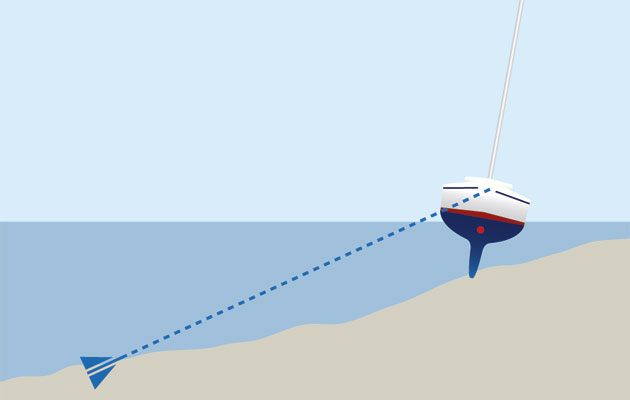
Speaking of depth, consider what sailors do when the sea is becalmed so no winds can fill the sails, or when a ship runs aground and can’t float. Mariners will row out in a smaller boat to sink an anchor a distance away.  The hawser, an attached rope, is then brought back to the larger yacht or ship, from where crew kedges—pulls on the rope until the vessel moves in the desired direction.

Page requirements are what make the game of writing possible. Even this blog is inspired by my goal to post 100 essays by Spring of 2020.  Without that goal, I might not be so focused or inspired. Goals, in this case page requirements, are the anchors we need to throw into an unknown depth to move our ship forward.  Let us all endeavor to count and to count on our words as vessels to help us navigate life in meaningful, deep, adventuresome, significant, and pleasurable ways that count.

                       Image result for kedging


Works Cited


Cameron, Julia.  The Right to Write. New York: Putnam, 1998.

Tuesday, April 23, 2019

Fishing for Knowledge

                                          Image result for teach a person to fish

           Gulls regurgitate fish into the gullets of their young.  Since they have to transport their catch over distances (during which their killings might be pirated by other birds), this is a crucial survival strategy. For the most part, the fish are not pre-digested, nor are the seeds and other fare birds regurgitate into the mouths of their young.  Granted, this image might be (to use a gustatory word) disgusting in the context of teaching. Let’s work this metaphor.

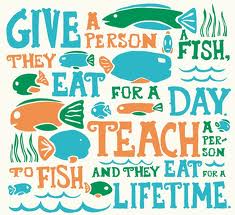
            According to a proverb variously attributed to Lao Tzu and Maimonides, “Give a man a fish, and he eats for day. Teach a man to fish, and they eat for a lifetime.”  The cover art revises that to a more inclusive gender-neutral aphorism (although it does use the plural “they” as a singular pronoun—more on that in another post). 

            In teaching, there are significant differences between ramming information down others’ throats (thus silencing them and making the material undigestible) and arranging fishing expeditions.  Yes, as a teacher I transport that which might nourish my students across time and space—the works of Plato, Shakespeare, Dickinson, Lao Tzu, Woolf—but to lecture extensively is literally to predigest and regurgitate my point of view into my students.  Then, according to traditional classroom practices, I peck-peck at them with one-answer questions so they can regurgitate what I said into the test booklet.

            More palatable is the image of giving students fishing poles and then sending them out to “catch” what they can on their own.  But if I give them all the same kind of fishing pole and bait, they are likely to return to drop their fishing lines into the same (can’t resist) school of fish and return with either nothing or the same fish over and over.  In classroom terms, this is to assign prompts, which, too often, amount to micromanaging student minds for more efficient assessment. See our link on Prompts, Proctors, Pornography.

            So, there are different fish for different folks. And different fish are caught with different strategies—hooks, various baits, nets, spears, hands, et cetera.  In my classes, this translates into showing students a range of techniques for plumbing Bram Stoker’s Dracula, for example.  We will interpret the same passage from a feminist point of view, and then compare that to how the passage would translate from other critical approaches that include Queer Theory, Marxism, Rhetoric, Structuralism, Deconstruction.  Our harvest will vary with how we explore.  Going on fishing expeditions together, we catch more than we could solo.

            Some people prefer to fish in streams with body boots—others drop nets in the ocean. And those who invented fishing poles (which are as vastly different as a string suspended from a stick to a digitally managed mega-reel on a tuna boat) invented them for their particular geography, resources, and needs.  Once we venture into literature with the usual tools, I encourage students to invent new tools that better serve their individual talents and needs.  Do you study the Bible?  Then take a biblical approach to our reading.  Do you love Harry Potter? Then compare one of his ventures to that of Ishmael in Moby Dick.  Are you interested in running for political office?  Cull quotes from Shakespeare’s history plays for your speeches.  In short, create your own fishing gear from the materials in your life.

            And what to do with the fish?  That will determine whether we fish, how, and by what means.  For some, the serenity of sitting in one place with a dropped line, soaking in dawn and stillness is enough.  Sitting with a book in one’s lap in a beach chair can be bliss. For others, the excitement of the hunt is sufficient—once the quarry is caught, it can be tossed back into its waters.  Once the grade is earned, the leased book can be returned to the bookstore.  Chefs plating tuna sushi; sculptors, photographers, poets embodying a rainbow trout; lacrosse players studying the swimming patters of quoi; musicians, caregivers, Uber drivers who listening to audiobooks between fares; trainers dancing with dolphins—so many fish, so many ways to relate with them.

            To teach is not so much to give students the fish, nor to just settle for giving them the equipment to catch them.  Ideally, a teacher helps students to identify their own fish, to create their own harvesting gear, to do fish in their own unique ways.

Works Cited